Summary:
Before committing to a new backbone for your operation, check these five boxes:
- Can a deal move from submission to funding without a single piece of data being re-entered or re-verified by a different department?
- Can your team modify a scorecard or adjust a risk threshold in 60 seconds, or are you tethered to a vendor support ticket every time the market shifts?
- When a payment fails, does the system automatically trigger a structured recovery workflow, or does your team have to manually reconcile portals to find out why?
- Are syndication splits and partner reports generated automatically from live deal data, or is month-end still a three-day manual scramble?
- If your deal volume doubled tomorrow, would your platform absorb the weight, or would you be forced to hire "data translators" just to keep the lights on?
If the software forces your team to reconcile instead of originate, it’s a liability, not an asset.
How to Pressure-Test Loan Management Software Before You Commit
Choosing loan management software isn't like choosing a CRM. If you make the wrong decision, you embed structural friction into underwriting, servicing, capital reporting, and compliance—and once your team is operating inside that system every day, the cost of undoing it is exponentially higher than the cost of getting it right upfront.
Pressure-testing a platform before you commit is operational due diligence. Here is how to do it—not during a guided demo, but under the weight of scale, exception handling, and capital scrutiny.
1. Can a Deal Move From Submission to Funding Without Being Rebuilt?
This is the most revealing test you can run.
Ask a vendor to move a deal from intake through underwriting and into funding while you watch for re-work. In many environments, the deal technically moves forward, but key elements are revalidated or re-entered along the way. Intake data might sync, but underwriting still verifies it manually. Approval terms may carry over, but funding confirms calculations in a separate spreadsheet.
If the context doesn’t travel intact, the system is just a collection of connected silos, not a lifecycle.
Inside Onyx IQ, for example, intake becomes a structured record immediately. Underwriting scorecards apply to that record, and funding actions execute within that same file. The deal progresses; it never restarts.
Tasha from Tekfi described this shift clearly when her team implemented Onyx IQ as a new funder entering a competitive market:
"As a brand-new funder entering a competitive market, Onyx IQ has been a strong foundation. We streamlined integrations across credit reporting and ACH processing, which eliminated the need to manage data input across multiple portals. The underwriting process is faster and more focused using the Scorecard."
2. Who Actually Controls the Credit Logic?
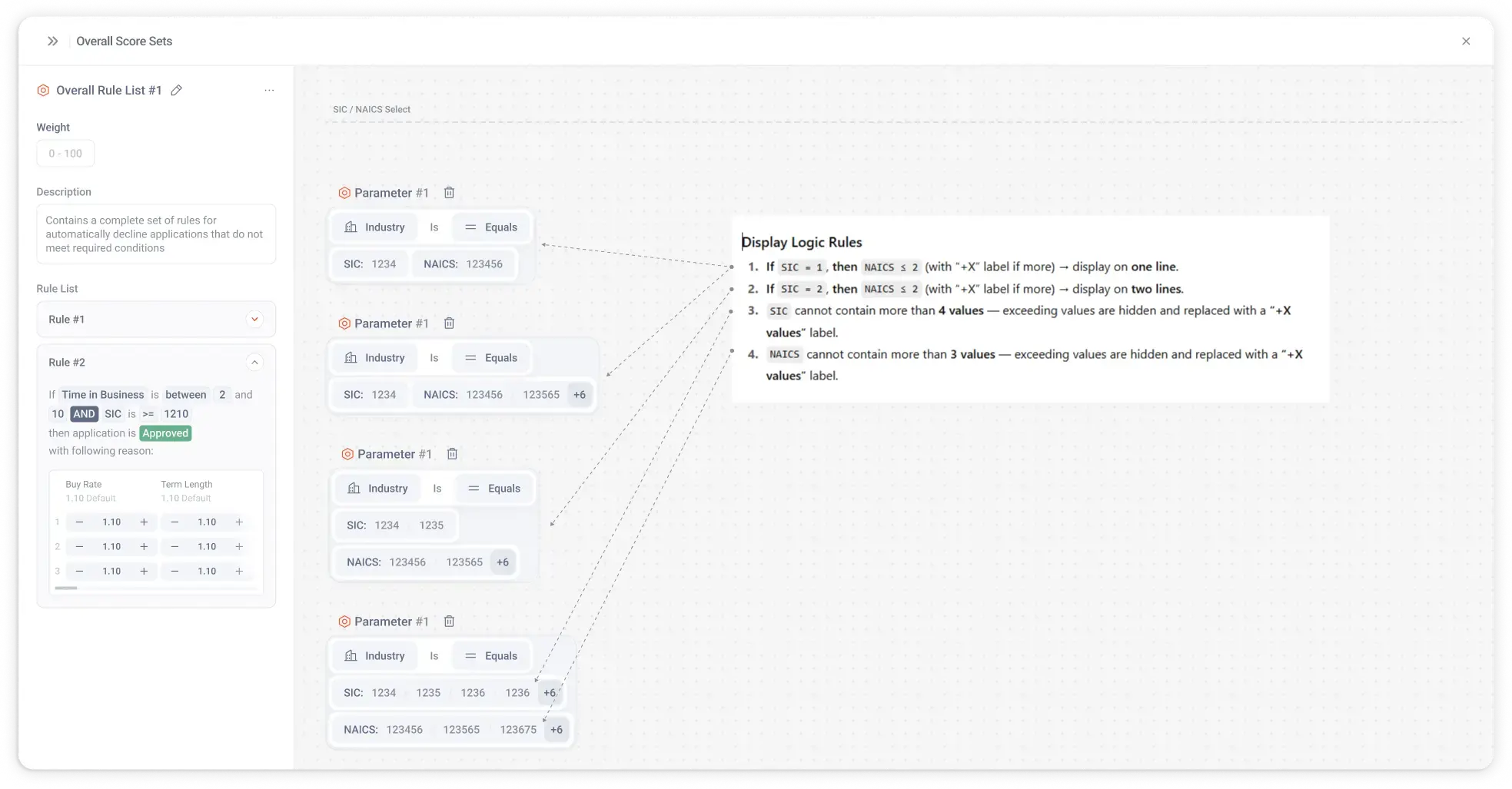
Underwriting criteria change and risk appetite evolves. If every adjustment to a scorecard or a decision threshold requires a vendor support ticket, you have effectively outsourced control of your credit policy.
Ask who can modify scorecards and refine rules. You want your operators to control this logic so changes can be made and tested in minutes, not weeks.
The operational impact of that control is tangible. Caleigh Toye from Liquify Funding shared how that played out for her team:
"Underwriting time dropped by roughly 30% thanks to automation and having all relevant data in one place. Everything—from intake and deal management to reporting—now lives in a single system, which has eliminated manual work and improved deal visibility."
Want to run these pressure tests on Onyx IQ directly? Book a walkthrough. We'll let you test the lifecycle yourself.
3. When a Payment Fails, Does the System Respond—or Does Your Team Scramble?
Servicing is where fragmented systems reveal themselves. When a payment fails, your team needs to know why the deal was structured that way without switching portals. If payment activity lives in a separate processor dashboard, every exception requires manual coordination.
Ask to see exactly where a failed payment appears and if it’s tied to the original underwriting notes. At volume, coordination becomes drag. Payment activity should sync directly into the deal record, triggering structured workflows that keep collections disciplined instead of improvised.
4. Does Capital Allocation Live in the Same Record as Performance?
Managing participation splits in a spreadsheet works until the book expands. If operational performance is tracked in one environment and capital allocation in another, someone must constantly bridge the gap.
Ask if syndicators are attached directly to deals and if participation percentages reflect the same performance data the servicing team sees. Choose a system where outstanding balance tracking and management fees are an extension of execution, not a separate reconciliation process.
5. What Happens When Volume Doubles?
This is the test many teams avoid because it forces an honest answer. A system that works at 20 deals a week can still strain under growth if its stages are loosely connected.
If submissions doubled next quarter, would your platform absorb the increase, or would manual coordination scale alongside it? Would underwriting queues remain structured, or would side-spreadsheets reappear? Infrastructure built for scale behaves differently under pressure. When the lifecycle is continuous, volume flows through structured workflows instead of multiplying handoffs.
Nick Lavoie from Lavoie Capital spoke about this kind of structural discipline from the beginning of his business:
“When I entered the MCA space, I was intentional about building the business with structure, compliance, and operational discipline from day one. I understood early that having the right systems in place would be critical to long-term success, and Onyx IQ quickly became a cornerstone of that foundation.
The platform gave me a professional, well-organized framework aligned with industry best practices, from legal compliance to streamlined application workflows. That structure removed unnecessary friction from daily operations and allowed me to operate with accuracy and consistency, even early on.”
Remember, infrastructure built for scale behaves differently under pressure.
6. Two More Critical Tests: Migration and Implementation
Beyond the daily workflow, you must test the switching cost and the time to Value:
- The Data Migration Test: Ask how your existing history transfers. If migration requires manual re-entry or loses historical context, you are starting your new system with a broken record.
- The Implementation Test: Ask what live actually means. Some vendors quote weeks but deliver months. Ask for the specific timeline for your specific integrations.
The Pressure-Test Checklist
Use this table during your next vendor evaluation to identify red flags before they become structural risks.
Why Leading Lenders Use Onyx IQ’s Automated Loan Management Platform as Their Operational Backbone
Onyx IQ was designed to solve the exact breakpoints that cause lending operations to fracture under growth. We believe that for a lender to scale without losing control, their infrastructure must meet four specific operational standards:
- Total Lifecycle Continuity: We eliminate the reconstruction of deals. Because intake, underwriting, funding, and servicing all live inside one connected record, the context that was captured at submission is the same context used for the final collection call. You stop paying the growth price of manual data re-entry.
- Absolute Policy Control: We believe the people running the shop should own the credit logic. Our platform allows operators to modify scorecards, adjust risk thresholds, and refine decision rules in-house. When the market shifts, you can pivot your system in minutes without waiting on a vendor support ticket.
- Embedded Credit Narrative: Our workflows are built with the understanding that servicing and collections are extensions of underwriting. When a payment fails, your team doesn't scramble; the system triggers a structured recovery path that inherits the original credit rationale.
- Automated Capital Alignment: We remove the reconciliation burden of syndication. By attaching capital partners directly to the deal record, participation splits and partner reporting become a real-time byproduct of your daily execution rather than a manual month-end project.
You Are Not Buying Features. You Are Choosing a Backbone.
If the lifecycle fractures between stages, your team will spend its time reconciling instead of growing.
Onyx IQ was designed to run the entire lifecycle inside one auditable system so the deal never resets as it moves forward.
Book a walkthrough and run these tests yourself. We’ll walk you through the lifecycle from intake to reporting and run these tests with you to see how Onyx IQ holds up under real-world pressure.