Lending Operations Automation
10 Signs Your SME Lending Operation Needs a Tech Makeover
How long has it been since you last updated your SME lending operations? It’s time for a rebuild if you’ve noticed any of these 10 signs.
Most lenders treat speed and oversight like two dials on the same panel—turn one up and the other comes down. The assumption is that it's inherent to lending, but it isn't. Lending isn't slow. The systems most teams use to manage it are.
Speed is the only currency that truly matters to a broker, but oversight is the only thing that keeps your capital partners from pulling their lines.
When teams prioritize speed in a broken stack, they skip steps, rely on gut calls, or bury updates in email threads to avoid the drag of switching between systems. The result is credit drift and audit failures. When they prioritize oversight, leadership adds manual double-checks, mandatory manager overrides, and committee reviews that grind TAT to a halt—and the deal goes to a faster competitor.
Neither outcome is acceptable at scale. The problem is that most lenders try to find a better balance between the two, the only way out of it is to remove the condition that puts them in conflict.
When intake lives in a CRM, underwriting happens in a spreadsheet, and servicing runs in a third system, the connection between those stages is a person.
There are three places where this breaks down:
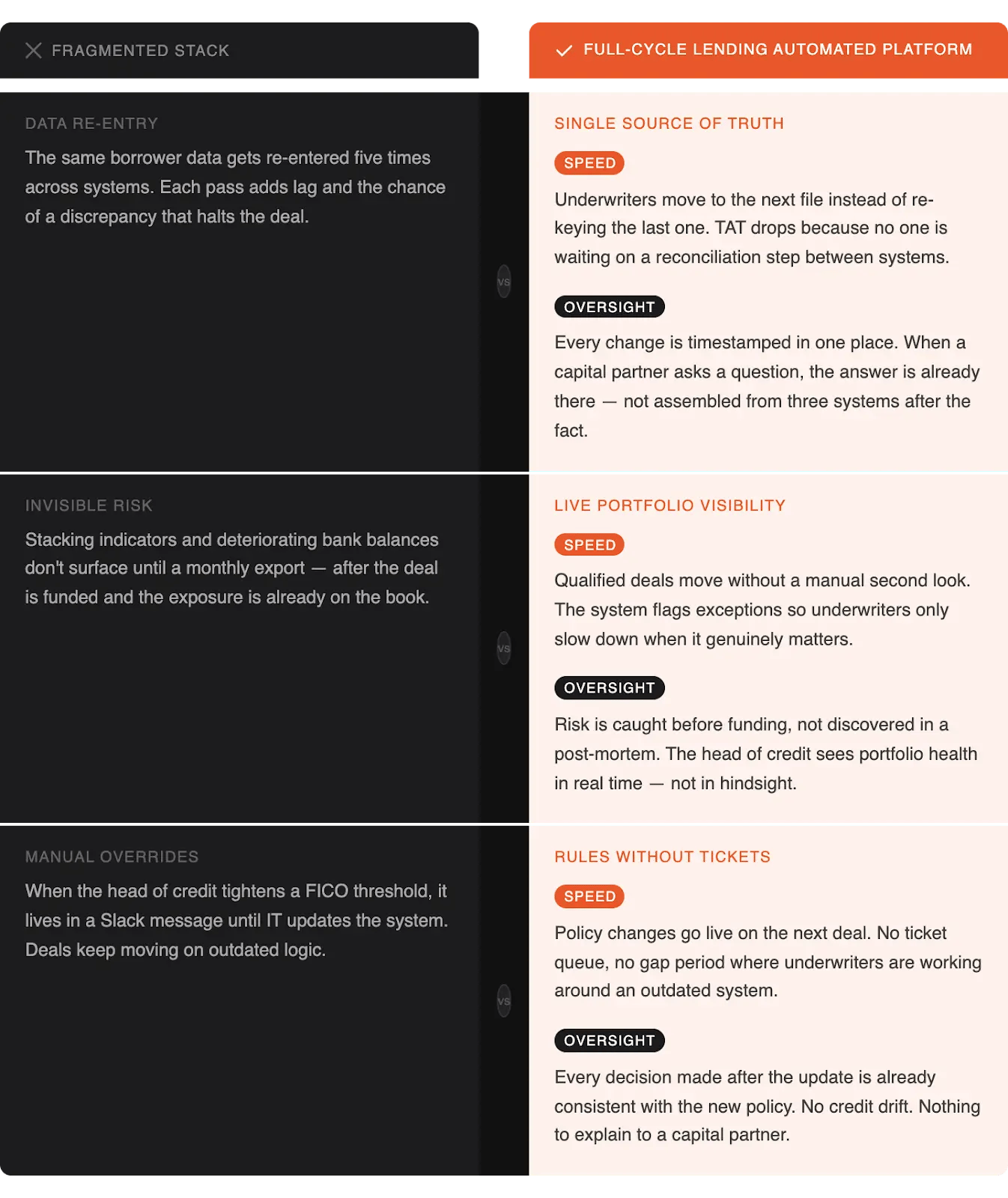
Data Re-entry: Lenders often re-enter the same borrower data five times across different systems. This is a failure of integration that introduces human error and kills your turnaround time.
Invisible Risk: Without a single system running origination and servicing together, underwriters miss stacking indicators and deteriorating bank balances until it's too late. By the time that information surfaces in a monthly export, the deal is already funded and the exposure is already on your book.
Manual Overrides: In a fragmented stack, credit policy consistency depends on an underwriter's memory. When the head of credit tightens a FICO threshold after a delinquency trend, that change lives in a Slack message or a team briefing until IT updates the system. In that gap, deals are still being evaluated against the old logic—and you're accumulating credit drift you can't easily explain to a capital partner.
Speed and oversight are only in tension when oversight is a manual layer sitting on top of the workflow.
When the logic that runs a deal and the record of that deal live in the connected same system, oversight becomes a byproduct of the work itself. The balancing ends when the architecture of your tech stack no longer forces the choice.
You get one platform and one source of truth.
When a submission comes in, the borrower record is created once and carries forward—through underwriting, funding, and into servicing—without anyone re-keying it. The credit memo populates from intake data. The servicing file opens from the funded deal. Every change and every document is timestamped in the same place.
For the CFO, that means a portfolio dashboard that reflects the live book, not last week's export. For the capital partner asking for a borrowing base report, the data is already there.
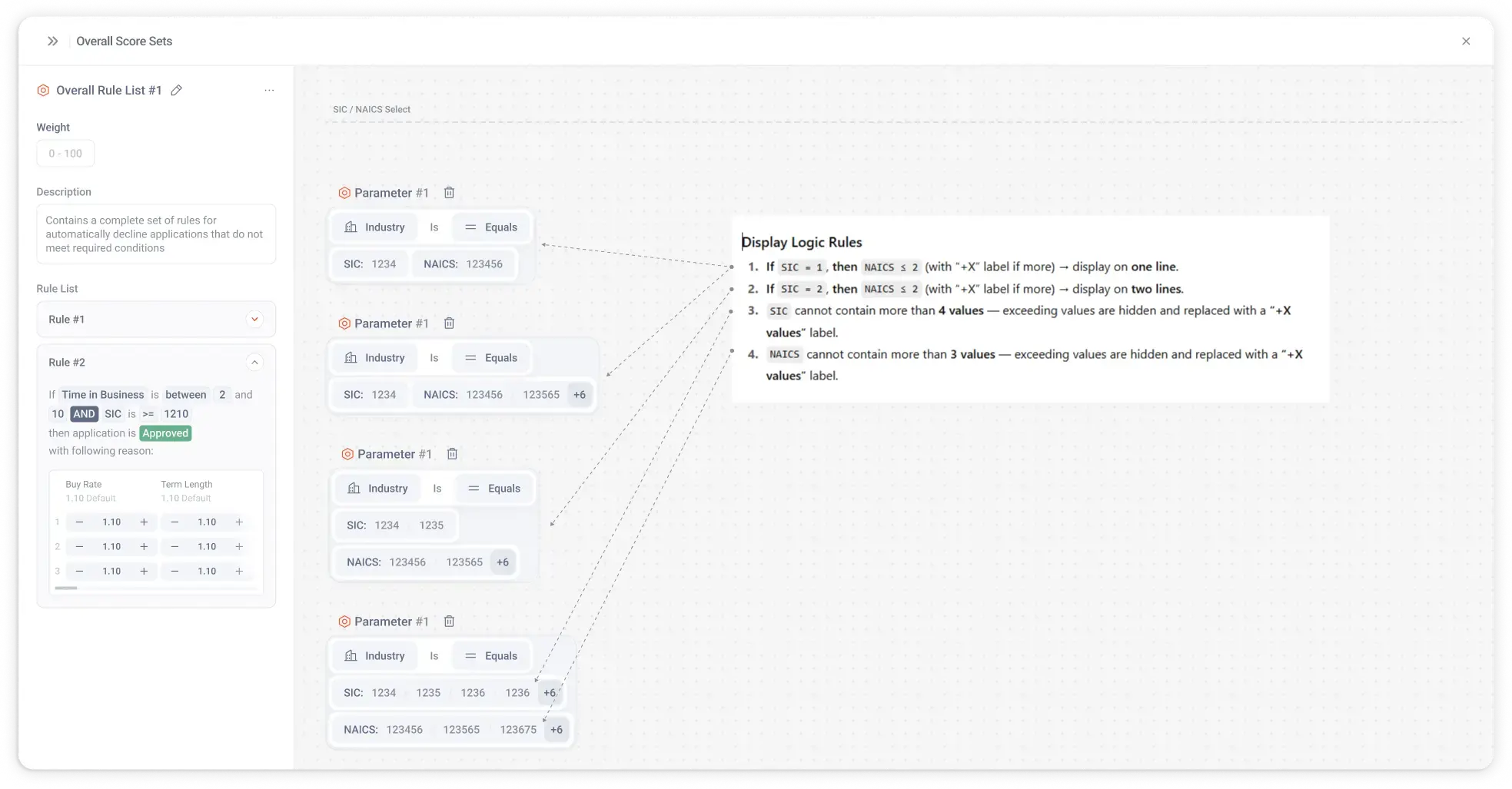
You can change rules without tickets.
When a delinquency trend shifts or a new product launches, the head of credit adjusts the relevant scorecards directly in the platform—reweights a variable, adds a threshold, changes a decision rule. The updated logic goes live immediately.
You don’t need an engineering ticket and avoid the gap period where underwriters are applying last quarter's policy.
Your deals are funder-ready from day one.
Every approval, exception, and status change carries a timestamp and a user ID. When a regulator asks to see the decision history on a specific deal—why it was approved, who signed off, what changed—the answer is already in the system.
The compliance record is a native output of how the deal moved through the platform, not a document assembled retroactively to satisfy an audit.
A submission comes in from an ISO. The two-way email integration pulls it directly into the platform—there’s no need for manual upload, no ops re-entry. An Experian soft pull runs from inside the system. The rule-based engine evaluates the deal against your configured credit logic: qualified deals route to the underwriting queue automatically; exceptions flag for review.
The underwriter claims the file. The credit data, documents, and intake information are already there. The underwriter approves it. The credit memo is generated from data already in the record.
The deal funds. The repayment schedule goes live in the same system. If a payment fails, the collections workflow triggers and the ops team sees it on the dashboard. If a syndicator wants to see their position, their view is live.
The head of credit runs a portfolio update directly from the platform. The data is current.
The underwriter didn't touch a spreadsheet. The ops manager didn't reconcile anything. The head of credit didn't build a report from scratch. The oversight ran alongside the deal.
The bottleneck at most growth-stage lenders is the manual overhead attached to every file. That overhead scales with volume. If you hire more people to process more deals, the overhead scales with them.
When the system automatically runs credit logic on every file, maintains a clean record of every step, and keeps reporting current without a manual pull, the per-deal administrative load drops.
Underwriters focus on files that need judgment, the head of credit manages the portfolio instead of managing the process, and the ops team runs deals instead of coordinating between systems.
Speed and oversight were never in conflict—they just look that way when your data is fragmented and your credit rules live in someone's memory. When you fix the architecture, the conflict disappears and you stop managing a balancing act and start running an operation.
Your team is managing this trade-off manually today, you’ll want to see what the workflow looks like when the system handles it. Book a 30-minute walkthrough of Onyx IQ here. No pitch deck. We'll walk the full lifecycle from intake to collections.
How long has it been since you last updated your SME lending operations? It’s time for a rebuild if you’ve noticed any of these 10 signs.
Ensure your MCA software vendor offers robust support. Discover essential questions to ask during demos to avoid costly issues later.
An LOS runs origination, an LMS manages the loan after funding, and an end-to-end platform does both. See the full comparison for MCA funders and...
Like what you're reading?
Make us one of your preferred sources on Google so our content shows up first.