Loan Origination
LOS vs. LMS vs. End-to-End Platform for MCA
An LOS runs origination, an LMS manages the loan after funding, and an end-to-end platform does both. See the full comparison for MCA funders and...
Merchant cash advances (MCAs) are a popular financing option for SMEs that need access to capital quickly.
Funders play a vital role in the MCA funding process. By providing timely access to capital, funders help SMEs address short-term cash flow needs, invest in growth opportunities, and navigate financial challenges. MCAs deals not only support SMEs, but they can be very profitable for all of the stakeholders involved in the process.
And yet, many funders look at $1M+ deals as something of an urban legend—they’ve heard of it, but they’ve never seen it.
These types of deals not only exist, but, with the right approach and mindset, are within reach of most MCA funders. In today’s article, we are going to take a look at some of the best practices that funders need to implement to close their first $1M+ deal.
It’s important to highlight the fact that big-money MCA deals do exist in the world of alternative lending.
Funder skepticism is understandable, and likely stems from the fact that in the alternative lending industry, the majority of deals tend to be smaller.
Although most MCA providers are accustomed to funding mom-and-pop businesses, a wide range of businesses need large sums of additional capital, especially given the current economic environment.
Large corporations, startups with ambitious growth plans, or established businesses looking to expand—they might all need a $1M+ cash advance to achieve their goals. They may require funding for a variety of reasons, such as purchasing new equipment, hiring additional staff, or acquiring other businesses.
In fact, recent data shows that the MCA industry is experiencing a period of significant growth, both by market size and deal size. The market is expected to reach $1.7 billion by 2027 (up from $620 million in 2021).
Before a funder can close a big-money deal, they (and the brokers they work with) have to find the right merchant… easier said than done.
One strategy is to focus lead generation efforts on industries or niches that are known to require larger funding amounts, such as technology startups, healthcare providers, and manufacturing companies. By targeting these industries, funders can increase their chances of finding larger deals.
A second strategy is to network and build relationships with other professionals in the industry—such as accountants, lawyers, funders, brokers, and financial advisors—who may be able to refer MCA funders to merchants that require larger funding amounts.
A final strategy for MCA funders seeking big-money deals is to harness the power of market research tools and platforms to identify businesses with high capital requirements. By utilizing advanced analytics, industry reports, and competitive intelligence tools, funders can gain insights into market trends and pinpoint sectors that are experiencing rapid growth or undergoing significant changes.
Some options (both paid and free) include:
Now that we know that big money deals exist, and are familiar with some strategies for finding the right merchants, it’s time to focus on funding.
Big-money merchants require a different strategy when compared to smaller ones, as these deals demand a higher level of due diligence and documentation.
The key is to approach these deals with a clear plan and a willingness to collaborate, as most merchants looking for this level of funding will have a team of attorneys and financial experts working with them.
Funders must also have a deep knowledge of the merchant’s business, and, as we’ll discuss below, intimately understand their financial statements. By conducting thorough research and analysis, MCA funders can ensure that they are working with the right merchants (i.e., those that have a reliable source of sustainable revenue).
Let’s look at some essential best practices for funding your first $1M+ deal.
Funding a big deal starts and ends with a funder’s knowledge base.
While this may seem obvious, in most cases, knowledge is a byproduct of years of experience in the industry (i.e., it’s highly unlikely that junior employees will be involved in a $1M+ deal)—but there are certain topics that MCA funders should educate themselves on.
First, funders need to know what is happening in the broader economy. They need to understand the impact of inflation, the COVID-19 pandemic, and interest rates.
Second, MCA funders need to understand a merchant’s business. Why does this merchant need capital? What’s happening within the merchant’s industry vertical? Speaking a merchant’s language and empathizing with the economic realities it’s facing will help build borrower confidence.
Lastly, know when to say “I don’t know.” If you don’t know something, own it. You can always find the correct answer in an expedited fashion, and merchants will respect you more for telling the truth.
One of the most crucial aspects of funding large MCA deals is transparency.
In some circles, MCA stakeholders have a reputation for “predatory” lending. While it’s unfortunate that bad actors exist in our industry, it’s a hard truth that funders have to face as they manage merchant relationships. A funder’s reputation is its currency—a good reputation is worth its weight in gold.
Funders must be transparent with merchants regarding the terms and conditions of the advance, including:
By being transparent, all stakeholders can build trust with merchants, help ensure that they fulfill their obligations under the agreement, and set themselves up for future business opportunities.
Proper documentation is another essential aspect of funding large MCA deals. Funders need to know their product, and know what stipulations they need to get the deal funded.
MCA funders must ensure that all documentation is properly collected in the initial stages of the engagement. While a typical approach for small deals may sound something like, “just send me an application and your three most recent bank statements,” this is not going to work for larger merchants.
Focus on real financials: proof of ownership, tax returns, P&L statements, etc.
This was a point raised by Wall Street Funding’s Mike Dell in our recent interview. Bigger merchants tend to be better organized with respect to financials, and funders can save a lot of time by asking for all necessary documents upfront.
The final piece of the $1M+ funding puzzle is agile lending technology.
That is to say, once you have found a big-money merchant, technology can help you manage the deal by streamlining processes, improving efficiency, and reducing risks via a centralized loan management platform.
Built to leverage the power of automation, a loan management platform offers all MCA stakeholders (funders, brokers, syndicators, merchants, etc.) a plethora of advantages that increase the probability that a deal will be successfully funded.
A modern lending platform drives efficiency in a number of ways.
First, by reducing time-consuming manual tasks. Second, by streamlining data collection and signatures. Third, by positioning all stakeholders to more cost-effectively scale operations (i.e., more merchants, more volume, fewer costs).
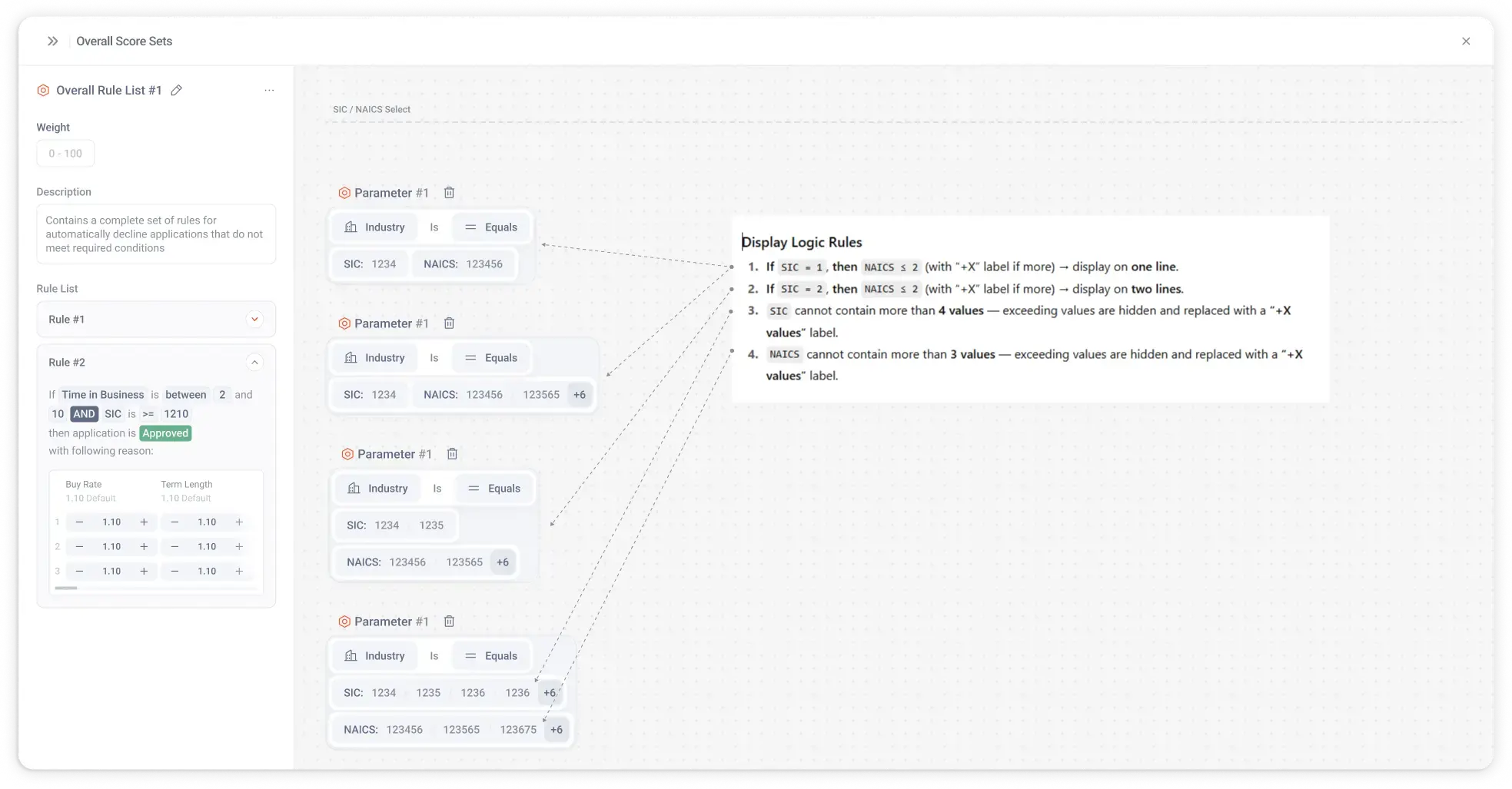
An agile loan management platform (business credit scorecards specifically) empowers funders to implement a standardized and repeatable process for evaluating creditworthiness, thereby increasing the accuracy and speed of the underwriting process so all parties can fund big deals faster.
As previously mentioned, a big-money deal is likely going to involve a lot of players. Funders, brokers, and syndicators on one side, lawyers, accountants, and the C-Suite on the other side, with everyone working together to get a deal done.
A smart loan management platform provides all stakeholders with access to a centralized system from which they can access data and play their role in the funding process.
If you are an MCA funder looking for your first $1M+ deal, implementing the best practices outlined above will help you move one step closer to finding and funding one.
Onyx IQ is here to help.
As a best-in-class loan management platform, Onyx IQ provides lending stakeholders with the technology they need to manage and fund big-money deals faster and more efficiently.
Whether you’re just starting your MCA operation, or you’re consistently funding $1M+ deals, Onyx IQ can meet your unique needs.
Interested in learning more? Demo Onyx IQ today!
An LOS runs origination, an LMS manages the loan after funding, and an end-to-end platform does both. See the full comparison for MCA funders and...
Learn how to transition your Merchant Cash Advance software smoothly without disrupting funded deals. Follow a five-phase migration framework for...
Discover how purpose-built MCA software streamlines operations beyond CRM capabilities, ensuring efficiency and accuracy in managing funded deals.
Like what you're reading?
Make us one of your preferred sources on Google so our content shows up first.