When the deal flow starts slowing down, you may eventually reach the conclusion that either the team is too small, or intake has outgrown the operation. It’s a reasonable assumption, because both are visible and easy to measure, until you realize neither explains why deals actually stop moving.
What actually determines whether your operation holds or breaks is not how many deals come in or how many people you have reviewing them. It’s how smoothly and quickly those deals move from submission to funding, and how many times it has to stop and wait for data to be re-entered, for the next person in the chain to pick it up, or for information to be reconciled across tools that don't talk to each other.
Volume and headcount only expose where that structure starts to fail.
Volume Exposes the Problem—It Doesn’t Cause It
At lower volume, manual coordination is enough to keep deals moving. Files get reviewed, missing information gets requested, and decisions get made without much friction because the number of active deals is still manageable.
As your business starts growing and intake volume increases, the number of manual coordination steps increases with it. Every step that requires a person to move the deal forward adds waiting time. You end up with idle time built into every stage, where deals sit until someone acts on them rather than the system advancing them automatically.
Hiring More People Doesn’t Fix the Problem
When that delay becomes visible, your default response may be to hire more processors to handle intake, more underwriters to review files, and more operations staff to support funding and collections. This reduces pressure at the individual points in the workflow, but it does not address the fact that you still have to manually connect those points.
Each additional person you hire adds another handoff, and each handoff adds dependency. A deal no longer moves based on completion of work alone, but on whether the next person in the chain picks it up, reviews it correctly, and passes it forward without creating rework.
Over time, deals are delayed because the process depends on too many manual transitions to stay consistent. That is how teams grow while cycle times continue to increase.
The Real Bottleneck Is Your System Architecture
If you look at how most lending operations are built, you’ll notice intake, underwriting, document management, payments, and reporting are handled in separate and disconnected systems, each designed for a specific function but not for the full lifecycle of a deal.
Because these systems are not connected, the process relies on people to bridge them. Borrower data is entered multiple times, deals are moved manually between stages, missing information is chased through email, and reporting requires reconciliation before it can be trusted.
This is where bottlenecks are created—at the transitions between tools and platforms. Deals slow down because the process requires multiple steps to be coordinated manually before underwriting can even begin, and again after a decision is made.
Lenders find themselves working across three to five different platforms just to move a single deal from submission to funding, with each transition adding up delay, increasing the risk of error, and reducing visibility into where the deal actually stands.
Where Bottlenecks Show Up Across the Lending Lifecyclee
Intake → Underwriting. Submissions arrive via email. Borrower data gets re-entered into the CRM by hand. Incomplete files sit in a queue before anyone flags them. The underwriter's first task on every deal is assembly, not analysis.
Underwriting → Decision. No enforced credit rules means two underwriters apply different thresholds to the same file type. Clarifications go back to ops via email, wait for a response, and sometimes come back incomplete. When the head of credit asks why a deal was approved, the answer is in someone's notes — not the system.
Approval → Funding. Contract generation is manual. E-sign chasing happens outside the platform. Every final check before funding is a human task running alongside other human tasks, with no visibility into what's complete and what isn't.
Servicing → Collections. A failed ACH pull on Monday surfaces to the ops team on Wednesday. Two more pull attempts have already run and failed. Collections gets triggered reactively — after the problem has already compounded.
Reporting → Oversight. The COO pulls numbers from the CRM, the ACH portal, and the servicing spreadsheet, reconciles the discrepancies, and sends a report that reflects the state of the book from three days ago. Decisions get made on outdated data.
Notice how the work isn't slow, the handoffs are.
How a Connected and Automated System Removes Bottlenecks
When the entire lending lifecycle runs inside a single automated system purpose-built for lending, those interruptions are removed because the process doesn’t depend on manual coordination between steps anymore.
For example, in Onyx IQ:
Intake routes automatically. A submission arrives from an ISO via two-way email integration— there’s no need for re-entry or manual upload. The borrower record is created once at intake and carries forward through every stage. The rule-based engine evaluates the deal against your configured credit logic before a human touches the file. Qualified deals route to the underwriting queue. Exceptions are flagged for review.
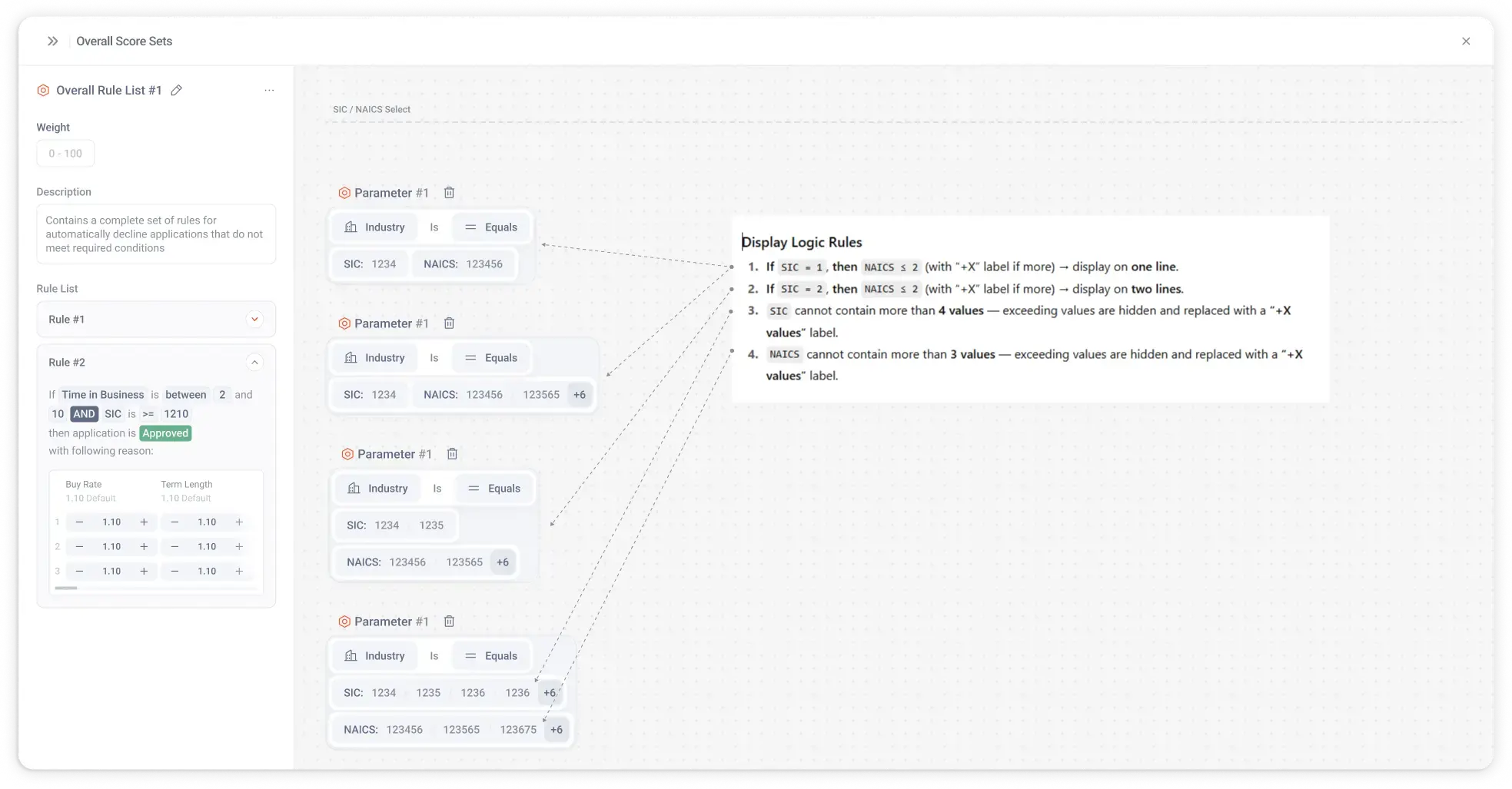
Underwriting runs on enforced logic. The underwriter claims the file. Credit data, bank balance history, stacking indicators, and documents are already there in one view—assembled by the system, not by the underwriter. The head of credit updates a scorecard threshold directly in the platform, and the next deal that hits the queue runs against the new rule immediately. There’s no need for an IT ticket or gap period.
Funding starts from a complete file. The credit memo populates from intake data. Documents, disclosures, and approvals carry timestamps in one place. There is nothing to chase before funding because the system tracks completion of every step automatically.
Collections triggers without a person noticing first. A failed ACH pull triggers the collections workflow the same day. The ops team sees it on the dashboard—not two days later in a summary email after two more pull attempts have already failed.
Reporting reflects today, not Thursday. The COO's portfolio dashboard pulls from live data. No need for an export, reconciliation, or Monday morning assembly project. When a capital partner asks for a borrowing base report, the answer is already in the system.
As you can see, the work stays the same, the only change is deals no longer wait between steps, they move on with the help of automation.
That is what allows teams to increase throughput without increasing headcount, because capacity is no longer used for coordination because coordination is done by the system, automatically.
Remove the Constraint—Don’t Staff Around It
Onyx IQ's automated loan management system was built to eliminate the gaps between stages by running intake, underwriting, contracting, servicing, and reporting inside one connected system. It enables deals to continue moving without depending on manual coordination at each step.
If any of those five handoff points look like your operation today, the fix isn't another hire. Book a 30-minute walkthrough of Onyx IQ here. We'll walk the full lifecycle from intake to collections running in one system.