The real bottleneck in almost every underwriting operation we’ve audited isn't analyst capacity. It's that every deal—regardless of how clear the outcome is—requires an analyst to evaluate it manually from scratch.
An obvious decline with a 490 FICO, three active positions, and six NSFs in the last 30 days gets the same underwriter attention as a borderline deal that genuinely needs judgment. An obvious approve with clean deposits, a two-year track record, and no stacking gets queued behind everything else.
Every deal waits its turn, and every deal consumes analyst time because there's no system separating the ones that do from the ones that don't.
Onyx IQ's rule-based scorecard engine changes that.
What Happens When Credit Policy Lives Only in Your Underwriters' Heads
The structural failure behind manual underwriting is that your approval logic exists as institutional knowledge—not as executable rules.
Your head of credit knows what a fundable deal looks like, your senior underwriter also knows, but that knowledge lives in conversations, in experience, in memory. It's never been encoded anywhere the system can automatically enforce.
The consequence runs in two directions:
First, every deal requires human review because the system has no way to separate the clear cases from the edge cases. An auto-decline that would take an automated scorecard a fraction of a second to identify takes an underwriter 7 minutes to confirm. Multiply that across 30 obvious declines a day and you've consumed 3.5 hours of analyst capacity on decisions that weren't decisions.
Second, undocumented credit policy drifts. Volume pressure, staffing changes, and the natural variation in human judgment mean the criteria applied on a high-volume Tuesday afternoon aren't identical to the criteria applied on a slow Monday morning. Not by much—but consistently enough that over six months, your portfolio reflects interpretations of your credit policy rather than your actual credit policy.
Neither of these problems is visible until the portfolio shows them.
How an Automated Business Scorecard Engine Changes the Mechanics
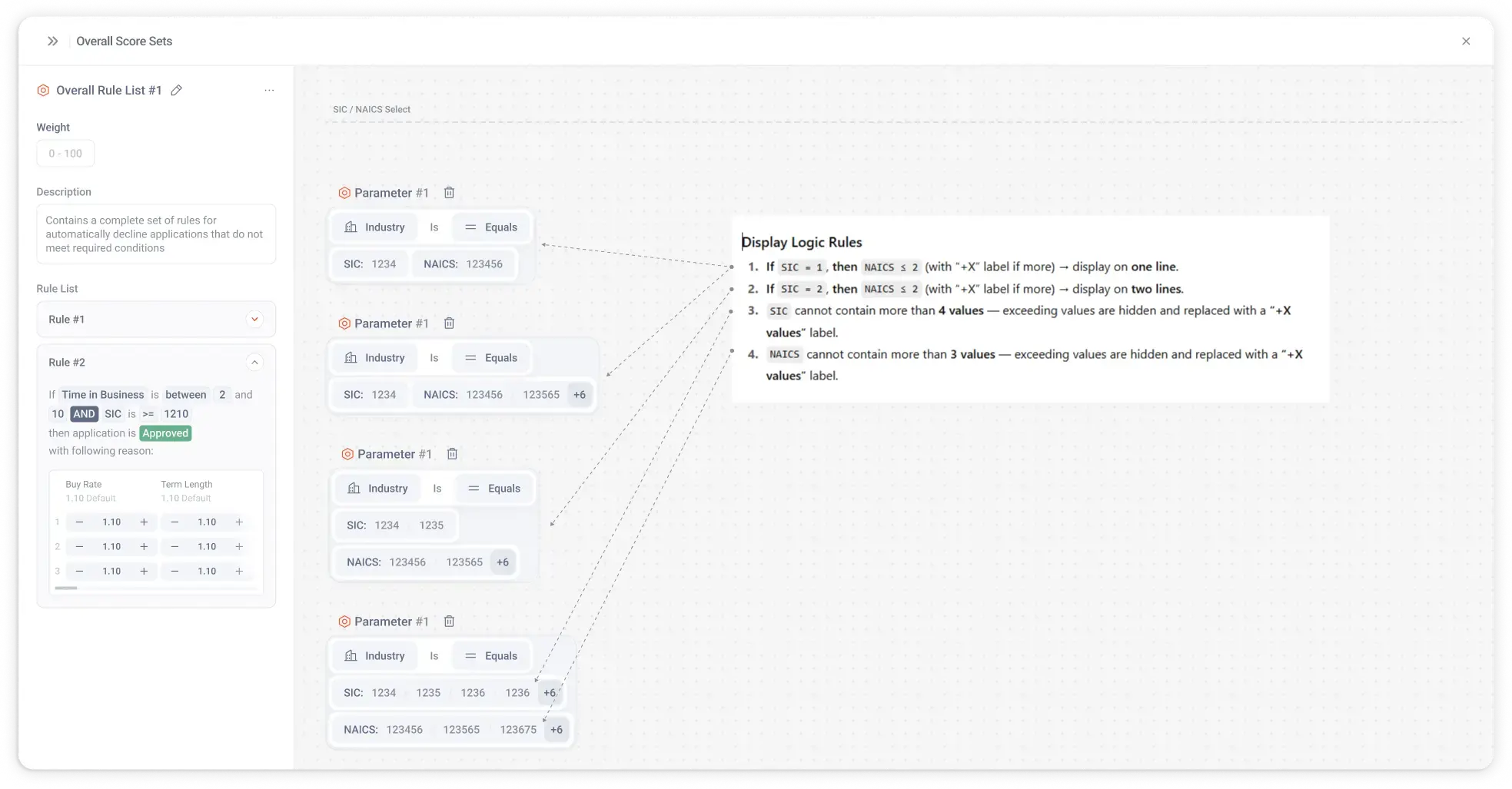
In Onyx IQ, your head of credit defines approval criteria directly inside the platform—FICO thresholds, time in business minimums, industry restrictions, average monthly deposit requirements, ledger position limits. Each rule is executable logic, not a guideline someone needs to remember.
When a deal enters the underwriting workflow, the scorecard runs automatically against those rules before any analyst opens the file.
A deal with a FICO score under your set threshold is auto-declined. An automated notification goes to the ISO immediately—no need to involve an analyst and no more delay while the file sits in a queue.
A deal that clears every threshold is auto-approved, and the ISO receives a branded notification with the offer details. Everything in between routes to the underwriting queue with a refer flag for manual review.
Your underwriter never sees the obvious declines. They never spend time confirming what the scorecard already knows. The queue they open contains the deals that actually require credit judgment—the stacked files where context matters, the borderline cash flow that needs a closer read, the merchant with an unusual industry profile that the rules flag for review.
Default stipulations auto-attach to every approval—driver's license, voided check, merchant agreement—so the underwriter doesn't manually add the same documents to every deal. Up to six approval options can be sent to the ISO in a single notification, covering different advance amounts or terms.
When your head of credit needs to update approval criteria—tighten the minimum deposit threshold after a bad month, restrict a high-default industry, adjust the FICO floor in response to portfolio data—the change happens inside the platform directly.
There’s no need for team briefings, spreadsheet updates, or waiting for the new standard to propagate across the underwriting team informally anymore. Scorecard versioning preserves every previous rule set, so every historical decision is traceable to the exact credit policy in place when it was made.
What Your Operation Gets Back
A client described the shift directly:
"Onyx IQ helped us streamline credit, ACH, and contract workflows into one system and made underwriting faster and more focused using the Scorecard."
Faster and more focused is the mechanical outcome.
When auto-declines and auto-approves are handled by the scorecard, your underwriters' time concentrates on the deals that need them. A senior underwriter who was spending a third of their day confirming obvious outcomes is now spending that time on the edge cases where their experience and judgment actually change the decision.
For a head of credit, the gain is control over something that was previously uncontrollable—the consistency of how credit policy gets applied across the team, across deal volume, and across time.
The rules are documented, enforced, and auditable.
A new underwriter added to the team works to the same credit standard as your most experienced analyst from their first deal in the queue. When the market shifts and your risk appetite changes, updating the policy takes minutes, not a team meeting. And over time, a portfolio built on consistent, system-enforced criteria reflects your actual risk appetite—not the accumulated judgment calls of whoever happened to review each deal on a given day.
That's what protects your margin as volume grows.
Onyx IQ: Where Credit Policy Becomes Operational Infrastructure
Onyx IQ is a full-cycle, automated lending platform built specifically for MCA and alternative lenders.
Its business scorecard engine isn't a standalone decisioning tool—it's embedded in the origination workflow, connected to the underwriting queue, and tied to every downstream stage of the deal lifecycle.
We spent two and a half years building the scorecard and rule-based engine because no other platform in the lending space had built it correctly. The technical challenge isn't defining the rules but making them executable in real time, versioned, and enforceable across every deal at any volume. That's the infrastructure your head of credit is operating when they update a threshold and the change takes effect on the next submission.
Every approval, decline, and referral is logged with the scorecard version and rule set that produced it—permanently auditable, never assembled after the fact.
See How The Automated Business Scorecard Engine Would Work With Your Credit Criteria
Every day your clear approves and obvious declines run through manual review, you're consuming analyst capacity on decisions the system should be making—and leaving your credit policy dependent on memory instead of infrastructure.
Book a walkthrough with the Onyx IQ team and we'll show you exactly how the scorecard and rule-based engine work—mapped to the credit criteria your operation already uses.