MCA servicing software manages advances after funding: ACH remittances, balances, returns, collections, syndicator payouts, and portfolio reporting.
Servicing gets harder as your MCA portfolio grows. Factor rates and remittances that can change with merchant sales require accurate tracking, yet many funders manage deals in a CRM, balances in spreadsheets, and payments in an ACH portal. Every new advance adds more updates, returns, and syndicator calculations, and eventually more staff to keep up.
MCA servicing software automates that work, helping your existing team manage more advances and spend more time recovering payments, managing risk, and keeping capital available for new deals.
This guide explains how servicing works, where manual processes get expensive, what software should handle, and how Onyx IQ approaches it.
Part 1 · The function
How MCA servicing works, and where it gets expensive
Every MCA deal moves through three stages:
- Origination and underwriting. Receive the submission, review the merchant, approve terms, and prepare the agreement.
- Funding. Collect signatures, send funds, and activate the advance.
- Servicing. Collect remittances, manage the account, and work toward renewal or payoff.
Servicing determines how much of your expected return you collect and what it costs to collect it. Missed payments, slow follow-up, errors, and additional staffing reduce your margin. Delayed collections also keep capital tied up longer, leaving less available for new deals.
MCA servicing vs. ACH processing vs. collections
Managing that return involves three connected functions:
| Function |
What it does |
| ACH processing |
Moves payments and reports whether they cleared or returned. |
| Collections |
Follows up on missed payments, delinquency, and recoveries. |
| MCA servicing |
Maintains payment histories, balances, account activity, and syndicator allocations throughout the advance. |
For example, when a $1,000 debit returns, the processor reports it, collections contacts the merchant, and servicing corrects the balance and any affected investor allocation.
When those systems don't share information, someone must update each one. A missed update can delay recovery, understate the merchant's balance, or trigger a payout against money you haven't collected.
What MCA servicing involves, step by step
Those connected updates continue from funding through payoff:
- Board the deal. Record the advance amount, factor rate, RTR, and payment terms. On an integrated platform, these already exist on the deal.
- Set the remittance schedule. Configure the amount, frequency, start date, and collection method.
- Initiate payments. Submit authorized debits or receive processor data, keeping pending payments separate from confirmed collections.
- Reconcile collections. Match payments to cleared funds, update remaining RTR, and flag discrepancies.
- Handle returns. Check the return code, reverse any provisional credit, and trigger appropriate follow-up.
- Process true-ups. Adjust remittances where the agreement calls for reconciliation, documenting the review and decision.
- Allocate syndicator payments. Calculate shares and fees from confirmed collections, accounting for pending or reversed allocations.
- Monitor the account. Keep balances, payment history, risk status, requests, and account changes together.
- Process renewals or payoffs. Provide accurate figures for renewal review. At payoff, stop collections and settle final distributions.
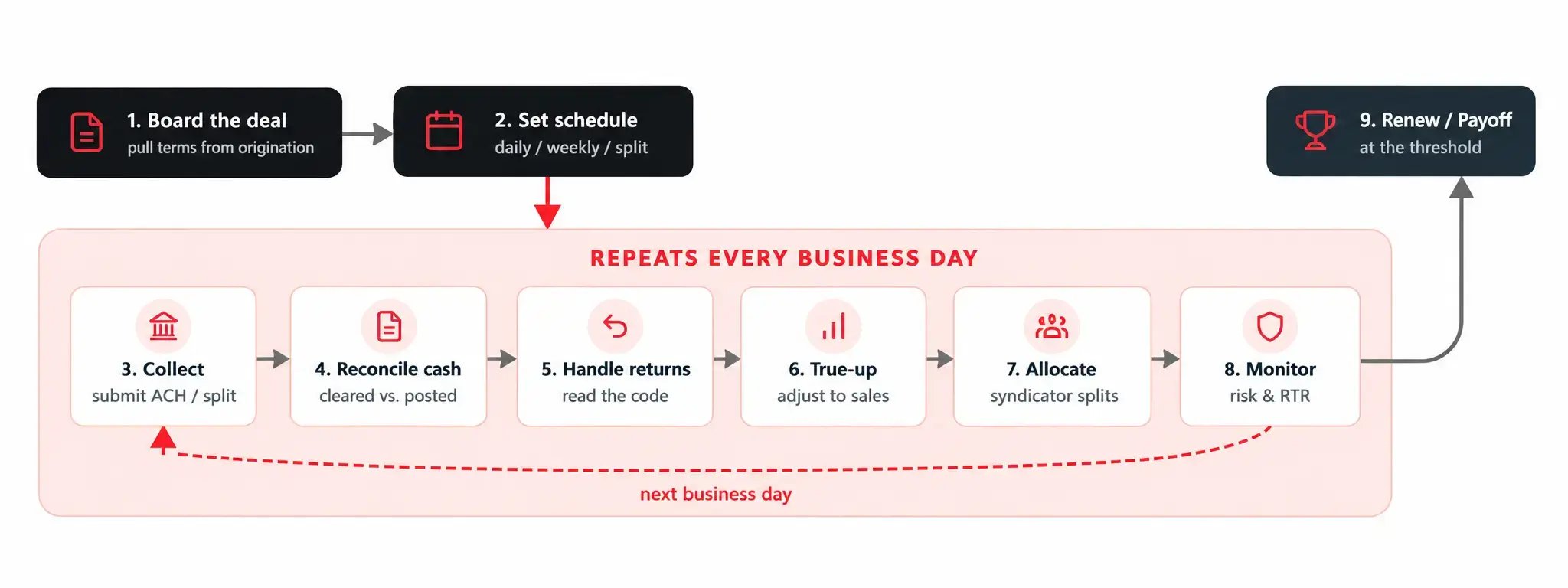
Steps 3 through 8 repeat throughout the advance. Across hundreds of accounts, checking ACH reports, updating balances, and calculating payouts becomes a substantial daily workload. Every manual update also creates another opportunity for an error.
What happens when an ACH payment returns
Returns need prompt attention because expected cash hasn't arrived. The response depends on the reason: insufficient funds, a closed account, and a disputed authorization require different action.
| Return code |
Meaning |
Initial response |
| R01 |
Insufficient funds |
Investigate and retry if permitted. |
| R02 |
Account closed |
Stop debiting the account and obtain valid payment instructions. |
| R03 |
Account not found |
Verify bank details before another attempt. |
| R08 |
Payment stopped |
Investigate before further action. |
| R29 |
Business account holder disputes authorization |
Suspend attempts under the disputed authorization and escalate. |
Incorrect retries can create fees, disputes, and compliance problems. Your system should identify the return, correct affected records, and flag the appropriate follow-up. Collections staff can then focus on resolving the issue instead of finding it.
MCA servicing example: from funding to payoff
Here's how those events affect a $100,000 advance.
| Deal terms |
Amount |
| Advance amount |
$100,000 |
| Factor rate |
1.40 |
| Purchased receivables / initial RTR |
$140,000 |
| Estimated daily remittance |
$1,000 |
| Estimated collection period |
140 business days |
If every $1,000 payment clears as scheduled, you collect $140,000 over roughly 140 business days. Returns and remittance changes affect that path:
- Day 0: funding. Send $100,000 and activate the agreed payment schedule.
- Day 1: collections begin. Initiate the first debit and record it as collected once confirmed.
- After 10 successful payments: $10,000 has been collected, leaving $130,000 RTR.
- Day 20: a payment returns. Record the return, reverse any provisional credit, and flag follow-up. Missing it could understate the balance and delay recovery.
- Day 35: an approved true-up. Sales have declined, and remittances change from $1,000 to $600 under the agreement. Remaining RTR is unchanged, but collections take longer, tying up capital beyond the original estimate.
- Renewal review: underwriting uses the current balance and payment history to assess additional funding. Incorrect figures can distort the new deal's economics.
- Payoff: stop collections, settle final distributions, and close the advance.
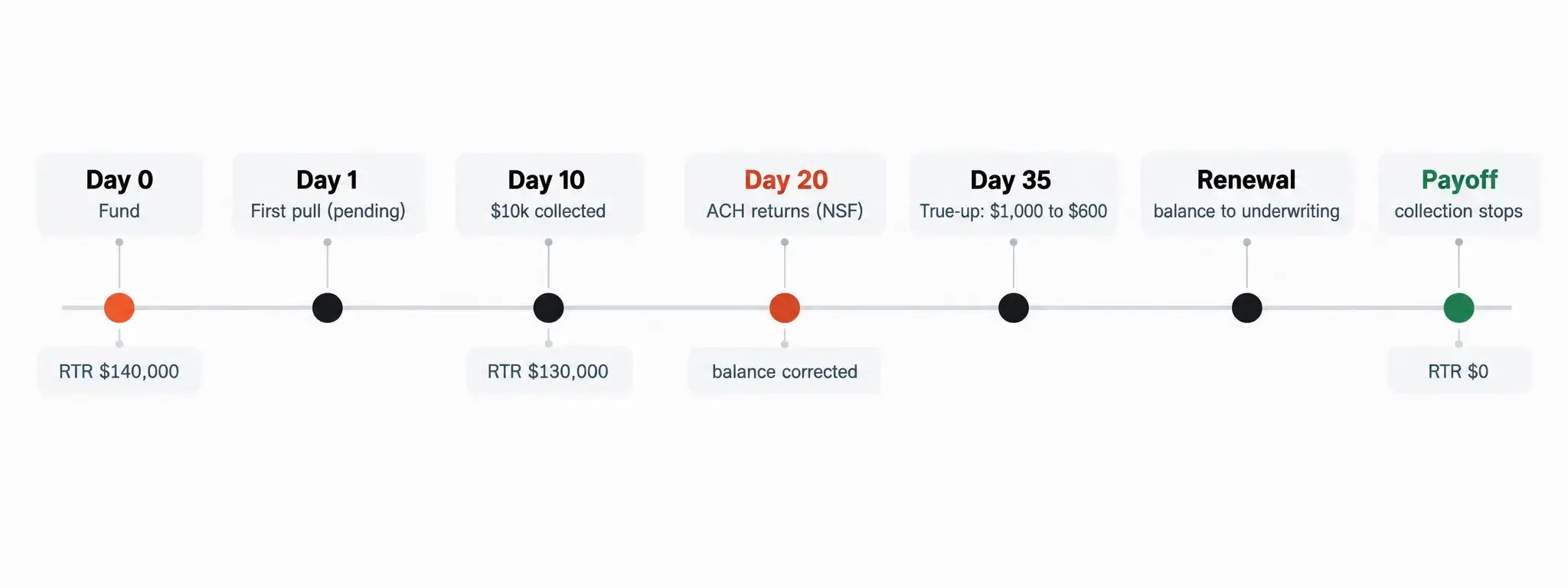
Accurate servicing shows what you've collected, what remains outstanding, and how payment changes affect when capital may return.
Signs you've outgrown manual servicing
The work above becomes harder to manage as active deals increase. Watch for these signs:
- Routine updates consume hours. ACH reconciliation, RTR updates, return checks, and syndicator calculations leave less time to work problem accounts.
- You're moving from brokering into direct funding. Putting your capital into deals also means managing collections, reconciliation, renewals, payoffs, and investor reporting.
- Your software needs workarounds. Daily ACH, RTR, renewals, or syndication still require spreadsheets because the platform doesn't handle your workflow.
The real trigger
Active deal count often creates more servicing pressure than dollars funded. Twenty large advances may involve far fewer payments, exceptions, and allocations than 400 smaller positions.
When your active book grows faster than your team can manage it, servicing starts limiting how much new business you can fund. Automation helps remove that constraint.
Part 2 · The software
What MCA servicing software should do
The right software reduces recurring work while keeping payments, balances, and allocations accurate. Start with the workflows your team already manages.
What is MCA servicing software?
MCA servicing software keeps post-funding activity on the deal record and automates tasks such as scheduled ACH, RTR updates, return handling, syndicator calculations, and renewals.
It comes in two forms:
- Standalone servicing tools handle repayment and connect to the rest of your stack.
- End-to-end lending platforms connect servicing with origination, underwriting, and funding on the same record.
Both should support your MCA workflows. Their structure affects how much information your team still needs to transfer or reconcile between systems.
Why regular loan servicing software doesn't fit a cash advance
Software built around amortizing loans may need configuration or additional tools to handle MCA. These differences create the most servicing work:
- Daily ACH increases transaction volume. Hundreds of daily debits bring more returns, holiday adjustments, and payment-plan changes than a monthly-payment workflow.
- Remaining RTR needs accurate tracking. A principal balance alone doesn't provide the figures needed for MCA payoffs, renewals, and syndicator statements.
- Every change affects the ledger. Payments, returns, adjustments, and renewals must update balances while preserving transaction history.
- Renewals can happen before payoff. Current balances and prior performance must carry into the next funding decision.
- Syndication affects each collection. Payments and reversals may change several investor positions with different participation percentages and fees.
Where the platform leaves gaps, your team fills them with spreadsheets and manual calculations. Those workarounds add cost and another set of records to reconcile.
What to look for in MCA servicing software
Focus on the tasks taking the most time and the errors with the biggest financial consequences.
1. An accurate servicing ledger
Every payment, return, and adjustment affects what remains to collect. Incorrect entries can carry into payoff quotes, renewals, and investor payouts.
| Transaction |
Remaining RTR |
| Advance funded |
$140,000 |
| First $1,000 payment clears |
$139,000 |
| Second $1,000 payment clears |
$138,000 |
| A previously credited $1,000 payment returns |
$139,000 |
| A $500 manual remittance clears |
$138,500 |
The ledger should preserve the original transaction and its reversal. Your team can then explain a balance change without rebuilding payment history in Excel.
That means less investigation work and more reliable figures for collections, renewals, and distributions.
2. The right servicing features
Beyond the ledger, look for capabilities that reduce daily administration.
| Feature |
What it helps your team do |
Priority |
| ACH integration |
See payment statuses and returns without separate processor checks. |
Critical |
| Payment reconciliation |
Catch missing or mismatched payments. |
Critical |
| Receivables reconciliation |
Process true-ups and document adjustments. |
Critical |
| Collections management |
Identify failed payments and keep follow-up moving. |
Critical |
| Portfolio reporting |
Spot underperforming deals and collection trends. |
Critical |
| Audit trails and permissions |
Trace changes and control sensitive adjustments. |
Critical |
| Syndication management |
Calculate allocations and reduce payout errors. |
Critical if you syndicate |
| Renewal management |
Review repeat funding using current balances and histories. |
High |
| Accounting integrations |
Reduce reconciliation between servicing and accounting. |
High |
| Merchant and ISO portals |
Reduce routine requests for balances, histories, and documents. |
Useful |
3. Syndication management
Syndication adds calculations with every deal and capital partner. On the same $100,000 advance with $140,000 RTR and a 30% syndicator:
- You contribute $70,000; the syndicator contributes $30,000.
- Your proportional RTR shares are $98,000 and $42,000.
- Each confirmed $1,000 collection creates a $300 syndicator allocation before applicable fees.
That's manageable on one advance. Across 200 deals, 15 partners, and different fee arrangements, returns and adjustments create substantial reconciliation work.
Distributing the $300 before the underlying collection is confirmed can also leave you recovering an overpayment if the debit returns.
Look for allocations based on confirmed collections, with participation, fees, pending distributions, and reversals tracked together. This reduces payout preparation and gives partners more reliable information as you grow.
What reporting should your MCA servicing software provide?
Accurate transactions should also help you understand portfolio performance. Higher funding volume can hide weaker margins if defaults, slower collections, or servicing costs are increasing.
| KPI |
What it tells you |
| Collection rate |
How actual collections compare with expected remittances. |
| ACH return rate |
How often debits return. |
| Outstanding RTR |
Purchased receivables still to collect. |
| Capital exposure |
Funded capital remaining at risk. |
| Delinquency and defaults |
Where accounts are falling behind. |
| Vintage performance |
How different funding cohorts perform over time. |
| Realized returns |
Earnings after relevant costs and losses. |
| Renewal rate |
Repeat funding activity. |
| ISO performance |
Which brokers submit deals that perform well. |
If one ISO's deals consistently default more often, you can review the relationship or tighten underwriting. If a vintage collects more slowly, you can investigate before committing more capital to similar deals.
RTR differs from profit. A $100,000 advance with $140,000 purchased receivables has a $40,000 gross spread. Commissions, capital costs, processing, servicing, and losses determine what you keep.
Reporting should account for those economics so your next funding decision reflects actual performance.
How MCA servicing software supports compliance
The same records help when a merchant disputes a debit, requests reconciliation, or challenges an adjustment. Keeping agreements, authorizations, payments, requests, and approvals together reduces the work of reconstructing events.
1. Showing that receivables reconciliation was honored
Where the agreement provides for reconciliation, record the request, review, decision, and adjustment.
That history shows how your team followed the agreement, including why a remittance changed and who approved it.
2. Supporting commercial financing compliance
Keep applicable disclosures, agreements, authorizations, and servicing histories accessible for reviews, disputes, and audits.
The benefit is faster document retrieval and a clearer account history. Have qualified commercial-finance counsel review the contracts, servicing practices, and retention requirements the software needs to support.
Buy, outsource, or build?
Once you know the requirements, compare three ways to deliver servicing.
Option 1: buy MCA servicing software
Buying lets your team retain control of merchant relationships, collections, and portfolio data while automating recurring work.
- Point solutions fill specific gaps, such as ACH processing or reconciliation. Include the work needed to keep them aligned: cheaper subscriptions can be offset by hours combining funding, payment, and investor records at month-end.
- End-to-end platforms connect origination through servicing and syndication. Approved terms carry into servicing on one record, reducing transfers, duplicate entry, and reconciliation.
Option 2: outsource servicing
A third party handles agreed tasks, potentially including ACH collections, merchant follow-up, reconciliation, and payouts.
This can reduce internal staffing needs, but adds fees, oversight, and reliance on another company for merchant interactions. Compare those costs with the workload removed and the responsibilities you retain.
Option 3: build your own servicing software
Building gives you control over features and workflows. It also makes development, processor connections, security, testing, and maintenance your responsibility.
Those costs continue after launch. Every processor change or new requirement becomes another development task.
Compare the total cost as your book grows: software, staffing, outsourcing, development, maintenance, reconciliation, and error correction.
How to choose the right MCA servicing software
Ask vendors to demonstrate the situations that create work in your operation:
- Board a $100,000 advance with a 1.40 factor, $140,000 RTR, and $1,000 daily remittance.
- Add a 30% syndicator participation.
- Record five successful collections.
- Return one previously credited payment.
- Show the corrected merchant balance and investor allocation.
- Process an approved true-up reducing remittances to $600.
- Calculate renewal and payoff figures.
- Show the transaction history, cash reconciliation, distribution, accounting export, and audit trail.
Watch what happens when the payment returns or the remittance changes. Check whether affected records update, whether the balance change is traceable, and whether anyone needs Excel to finish.
A few manual minutes per advance become hours across a large book. Compare subscription prices alongside the staff required at today's volume and at twice the active deal count.
Part 3 · The solution
How Onyx IQ does it
Onyx IQ connects origination, underwriting, funding, servicing, collections, and syndication on one deal record. Here's how that reduces the workload described above.
1. Manage the entire deal from one record
Separate systems require transfers and checks each time an advance funds. Onyx IQ carries origination data into servicing, reducing duplicate entry and discrepancies.
Your team can manage more active advances with less work moving information between systems.
2. Automate syndicator calculations and payouts
Onyx IQ tracks participation and fees and calculates payouts from confirmed collections. Partners can review positions through an investor portal and use virtual wallets to hold or redeploy capital.
Your team spends less time preparing distributions, correcting allocations, and answering routine balance questions.
3. Manage ACH payments from the deal record
Integrated ACH activity brings payment statuses into the deal instead of leaving staff to check a separate portal.
Your team can identify returns sooner and spend more time following up on missed collections.
4. Follow up on payment problems faster
Failed payments can enter a Payment Issues queue and trigger merchant follow-up by text and email. For external collections, Onyx IQ can package payment history and supporting documents.
Reps spend less time identifying issues and gathering files, leaving more time to resolve payment problems.
5. Service MCAs using MCA-specific terms
Onyx IQ supports factor rates, RTR, daily remittances, payment adjustments, renewals, and syndicator splits.
Your team needs fewer side calculations and workarounds as the active book grows.
6. Report on portfolio performance
Onyx IQ provides vintage analysis, static pools, collection curves, and financial reporting outputs. Its SOC 2 Type II assurance also supports security reviews.
Your team can spend less time assembling reports and more time identifying weak collections, capital exposure, and stronger-performing deals.
See Onyx IQ handle a live servicing scenario
Bring a returned payment, true-up, or syndicated deal. We'll show how Onyx IQ handles the balances, allocations, follow-up, and reporting using your numbers, so you can see where your team could manage more advances with less manual work.
Book a demo
MCA servicing software FAQ
1. What's the difference between MCA servicing and ACH processing?
ACH processing moves payments and reports their status. Servicing manages the wider post-funding process: balances, payment histories, reconciliation, collections, and syndication.
2. What are the two types of reconciliation in MCA servicing?
Payment reconciliation matches recorded payments to actual collections. Receivables reconciliation, or a true-up, adjusts remittances based on sales where the agreement requires it.
3. Do I need separate origination and servicing software?
You can use separate systems if they exchange information reliably. An integrated platform keeps both on one deal record, reducing transfers and reconciliation.
4. Can you outsource MCA servicing?
Yes. Providers can handle payments, reconciliation, merchant follow-up, and other tasks. Compare the workload removed with fees, oversight, and retained responsibilities.
5. Is RTR the same as profit?
RTR tracks purchased receivables. A $100,000 advance with $140,000 RTR has a $40,000 gross spread; actual profit depends on collections after commissions, capital costs, servicing, fees, and losses.
6. Why doesn't regular loan servicing software work for MCAs?
Platforms built around amortizing loans may need configuration for RTR, daily remittances, true-ups, renewals, and syndication. Without that support, your team fills gaps with spreadsheets and manual calculations.
7. Does Onyx IQ handle the full MCA lifecycle or just servicing?
It connects origination, underwriting, funding, servicing, collections, and syndication on one deal record, carrying approved terms into servicing.
8. Which ACH processors does Onyx IQ integrate with?
Onyx IQ has native integrations with five ACH processors: ACH Works, Actum, ACH.com, UZO, and Wells Fargo, with an open API for additional connections. Confirm your preferred processor and supported workflows during the demo.
9. Does Onyx IQ automate MCA syndication?
Yes. It tracks participation and fees, calculates payouts from confirmed collections, and gives syndicators access to positions and wallets. Ask to see how returns and defaults affect your allocations.
10. Does Onyx IQ automate collections?
It supports failed-payment queues, automated merchant messaging, and preparation of files for external recovery, reducing the administrative work around collections.
11. Is Onyx IQ SOC 2 Type II certified?
Onyx IQ reports SOC 2 Type II compliance. SOC 2 is an attestation report; request the current report to review its scope and coverage.
12. Does Onyx IQ provide institutional reporting like static pools and GAAP outputs?
Onyx IQ offers static-pool, vintage, collection-curve, and financial reporting capabilities. Review sample outputs with your accountant and capital partners to confirm they meet your requirements.
13. How long does Onyx IQ take to implement?
Implementation depends on integrations, contracts, configuration, and active-book migration. Confirm the timeline with the Onyx IQ team, including setup, testing, and your team's responsibilities.
14. Who is Onyx IQ built for?
Onyx IQ serves MCA and alternative-lending funders, from small shops to larger teams, with workflows built around factor rates, RTR, daily remittances, renewals, and syndication.