Skip to content
 
 
 HOW MUCH RENEWAL CAPITAL IS SITTING UNTOUCHED IN YOUR BOOK?

MCA renewal opportunity calculator

Your best next deal is a merchant who already paid you back. Put in your numbers and see what a manual renewal cycle is costing you every year.

Takes about 30 seconds No sign-up to see your number Built for MCA & alternative lenders
Enter your book

Adjust these five inputs to match your operation. The opportunity updates as you go.

38% of small firms applied for financing in the last year, and more are turning to online lenders.1

A lot of that demand is already sitting in your own portfolio.

Your merchants will need capital again. Will you reach them before another funder does?

Your book

Hover an i for what each one means. Defaults reflect industry norms.
Active deals iHow many deals are live on your books right now. 200
Average advance iThe typical dollar amount you fund on one deal. The industry median for repeat borrowers is about $50K. $50,000
Average term iHow long a typical deal takes to fully pay off. Shorter terms mean each deal comes up for renewal more often, so your book creates more chances per year. 8 months
Renewal rate iOf the merchants who become eligible to renew, the share you actually re-fund today. Set this to your real number. Manual, ad-hoc shops often sit in the 10 to 20% range. 40%
Factor rate iHow much a merchant pays back per dollar advanced. 1.30 means you send $1.00 and they pay back $1.30, a 30-cent margin. This drives your gross-profit numbers. 1.30
The opportunity
Your book creates about 300 renewal chances a year. Here's what you capture today, and what a systematic engine (65%, the top of the industry band) would capture.
You capture today40%
 
120 renewals · $6.0M funded · $1.8M gross profit
A systematic engine captures65%
 
 
195 renewals · $9.8M funded · $2.9M gross profit
The gap you're leaving every year
$3.8M
in funding volume
$1.1M
in gross profit
75 renewals you're eligible to do but aren't.
The industry benchmark is renewal within six months of payoff.2 That gives competitors a long time to get in first.
If your team only checks renewal eligibility once a week, a merchant can become ready to renew, sit unnoticed for days, and get a refinance or stacking offer before you ever reach out.
A big part of the renewal gap comes down to who gets there first.
How this is calculated & where the numbers come from+
In-text references
  1. Market context (38% applied; rising online-lender applications). Federal Reserve Banks, 2026 Report on Employer Firms, 2025 Small Business Credit Survey. fedsmallbusiness.org, government data.
  2. Renewal band (55–65% renew within six months of payoff). Cited across MCA trade sources and often credited to the Federal Reserve Bank of New York, but a primary Federal Reserve publication was not independently verified, so it is presented here as a directional industry range.
Where the default inputs come from
  • Average advance (~$50K, repeat-borrower median). MCA industry surveys, compiled by Crestmont Capital. crestmontcapital.com, industry estimate.
  • Average term (6–9 months most common). MCA industry estimates, compiled by Crestmont Capital. crestmontcapital.com, industry estimate.
  • Renewal rate (low-touch shops run 10–20%). Practitioner observation for lenders without systematic renewal outreach, not a government statistic. Set the slider to your own measured rate.
  • Factor rate (1.2–1.3x for established merchants). MCA industry data, compiled by Crestmont Capital. crestmontcapital.com, industry estimate.

Method: Renewal-eligible merchants/year = active deals × (12 ÷ average term in months), reflecting how often your book pays down and becomes eligible. Gap = eligible × (65% − your current rate). Funding volume = gap × average advance. Gross revenue = funding volume × (factor rate − 1); this is gross of losses and cost of capital, and the industry default rate runs roughly 15 to 20%. The 65% target is the top of the industry renewal band, used here as a ceiling. That band measures how many merchants renew with any funder, so not every eligible merchant will re-fund with you. Treat the gap as the upper bound of the opportunity, then set the current-rate slider to your own measured number. This is a directional model to size an opportunity, not a forecast or a guarantee of results.

Free playbook

Fund more renewals from the merchants you already have.

We put the whole system in one playbook, so you can spot renewal-ready merchants and reach them before another lender does. Here's what's inside:

  • The four-part renewal process. When a merchant is eligible, when to reach out, what to offer, and how to review the deal safely.
  • Where manual tracking breaks. Why spreadsheets make teams miss renewals, and how to fix it.
  • A print-and-keep checklist. Decide which merchants are safe to renew, on one page.
  • A full renewal reference. The renewal math worked through, industry benchmarks, and the metrics to track.
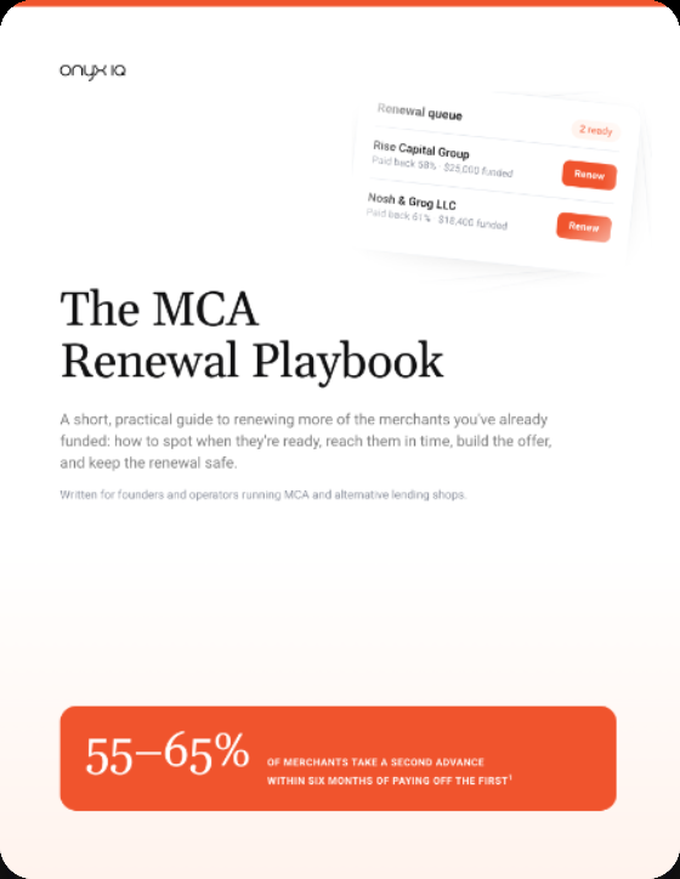
The MCA Renewal Playbook cover
Instant download. We'll email you a copy too. No spam.
 
About Onyx IQ

Your renewals run in the same system as everything else.

Onyx IQ is a full-cycle lending platform for alternative lenders. It replaces vendor patchwork with one auditable system for origination, underwriting, funding, syndication, servicing, and collections. Renewals live where the rest of the deal already does, so the signal to act and the workflow to act on it sit on one record instead of a CRM, a spreadsheet, and an ACH portal.

One platform, one source of truth

A merchant's full history stays on one deal record across the lifecycle, so when a renewal comes up you already have the repayment story in front of you and nothing has to be stitched back together.

Repayment status in real time

Onyx keeps RTR and repayment status current, so you can see which merchants have paid down far enough to be renewal-ready without rebuilding a report every week.

Stacking read at underwriting

OCR reads bank statements and surfaces new positions and stacking, so you re-underwrite a renewal on what is actually happening in the account, not on the fact that payments have been clearing.

Syndication that keeps up

When you fund the renewal, syndication allocations and investor reporting update in the same system, so partner views stay accurate and you are not reconciling them by hand afterward.