There is no single "best" Loan Origination Software (LOS) for MCA lenders. But purchasing the wrong one can cost you more than the platform itself. If you need to switch platforms 12 months after deployment because yours couldn’t keep up with your growth, you’ll have to run 4 to 6 months of re-implementation, parallel system costs, and re-training across your ops, underwriting, and servicing teams.
The right LOS for your funding business is the one that matches your monthly volume, syndication needs, and compliance requirements. The platform you pick for the operation you have today should also fit the operation you'll have in 18 months.
This guide compares 8 LOS platforms for MCA lenders in 2026 — Onyx IQ, Centrex, Cloud Lending, CrestSoft, HES FinTech, LendFoundry, LendSaaS, and TurnKey Lender — and helps you match the platform to your operation.
The Short Version
Onyx IQ runs the entire loan lifecycle on one platform — origination through portfolio reporting — without third-party glue. Best for mid-to-large MCA funders with capital partners and institutional syndicators, with a path to commercial term loans on the same platform.
LendSaaS is full-cycle but lighter on institutional reporting. Best for direct funders running an MCA-only operation that prioritizes simplicity over reporting depth.
Centrex Software is a finance CRM with origination, servicing, and syndication features layered on top. Best for small MCA shops under 20 users escaping spreadsheets on a tight budget.
LendFoundry is a multi-product cloud-native platform supporting MCA, SME, and consumer lending with AI-based decisioning. Best for enterprise alt-lenders with the IT budget for configuration.
TurnKey Lender covers MCA, micro-loans, BNPL, and other alt-lending products with AI decisioning. Best for diversified alt-lenders accepting less MCA-specific depth.
HES FinTech offers configurable modules for origination, underwriting, servicing, and reporting. Best for banks and lenders with engineering resources for ongoing configuration.
Cloud Lending (Q2) is a Salesforce-based enterprise platform covering origination, servicing, and collections. Best for organizations already invested in Salesforce.
CrestSoft is a smaller, MCA-focused platform covering applications, underwriting, payment processing, and collections. Best for boutique MCA funders under 10 users.
What Actually Matters in Origination
5 things determine whether a loan origination platform handles origination well:
1. How applications get into the system
The fastest LOS doesn't help if your ops rep is still copying data from email attachments by hand. Look at how each platform handles the four ways deals come in: a broker portal where ISOs submit directly, an application form on your website, an API for partner integrations, and email with bank statements attached.
The one most MCA funders underestimate is two-way email integration with OCR. Brokers don't always submit through portals — they email PDFs at 4:50 PM on Friday. A platform that creates the deal record automatically and runs OCR on the bank statements turns 30 minutes of manual entry into 30 seconds of review.
2. How fast underwriting can decide
Underwriting speed is the difference between funding a deal and losing it to a competitor.
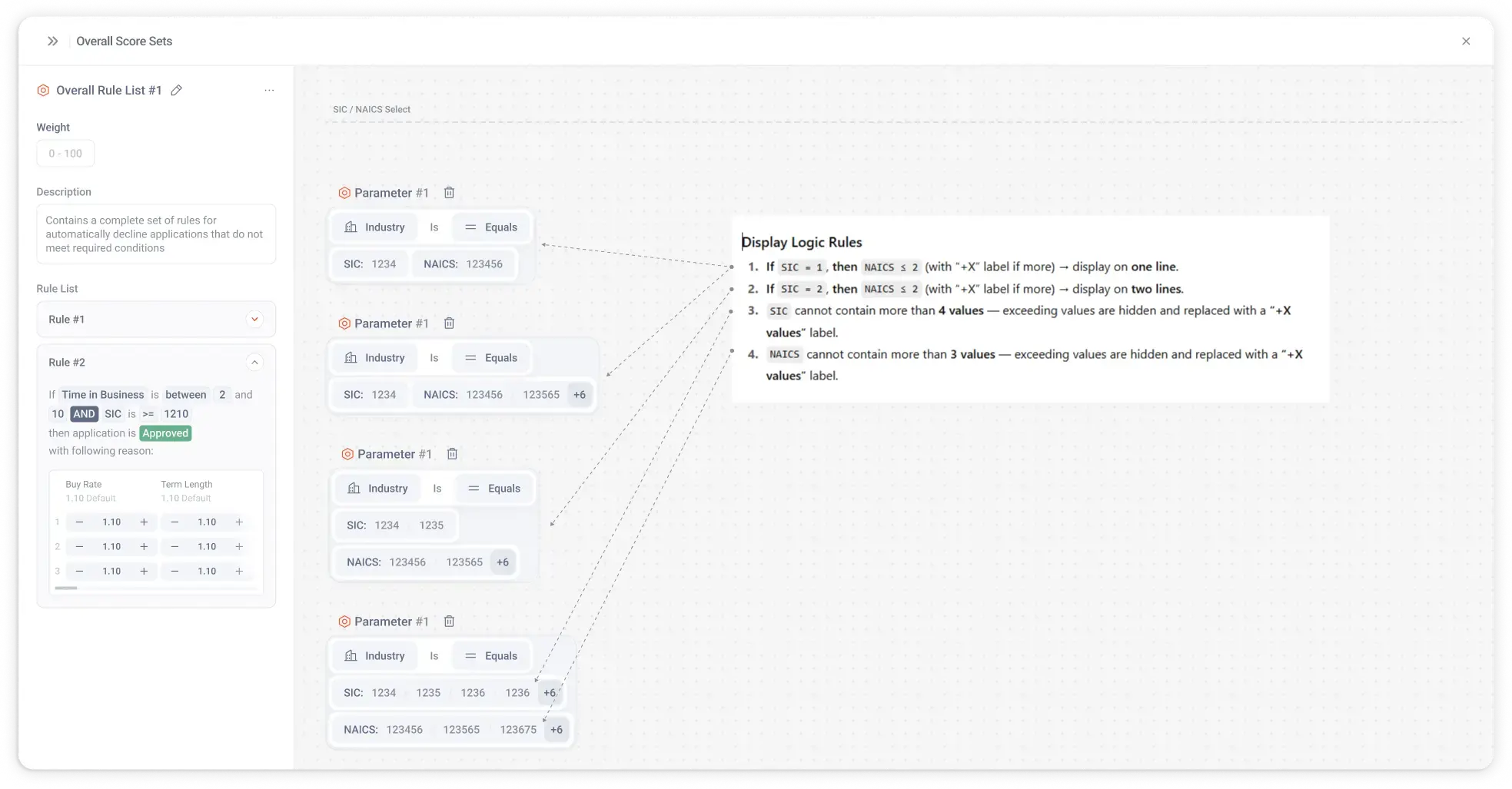
Look for a platform where your head of credit can build, change, and update credit rules without writing code or filing a ticket — a scorecard engine where every rule is visible on screen, every change creates a new version, and every approval is logged with the exact rule set that produced it.
The LOS should be able to auto-approve the clean deals (FICO above your threshold, monthly deposits above $25K, six months in business, no NSFs in the last 30 days) and let your senior underwriter focus on the edge cases. Without no-code rules, every credit policy change goes back to the vendor and can take weeks.
3. What data the platform pulls automatically
Most of the work in origination is gathering data — bank verification, credit reports, KYB, fraud signals, alternative data.
Look for pre-built integrations with the vendors your team already uses: Plaid or DecisionLogic for bank data, Experian for credit, Thomson Reuters CLEAR for KYB, MoneyThumb for bank statement OCR.
Every pull your ops rep doesn't have to start manually saves 10-15 minutes per deal. Ask each vendor for the integration list, and ask which ones are ready out of the box versus which ones need custom work. Pre-built integrations run on day one. Custom integrations may be 4–8 weeks of engineering work each.
4. What happens after approval
This is the question most demos skip. When your underwriter approves a deal at 2:00 PM, what happens at 2:01 PM? In a one-platform setup, the same deal record moves straight into contract generation, ACH setup, and funding — without anyone touching it. In a stitched-together setup, your ops rep re-creates the deal in the servicing tool, sets up the ACH schedule manually, and pulls the contract template from a third system. That's 20 to 30 minutes of work per approved deal — and at 50 deals a week, that's a full-time person doing nothing but moving data between systems.
Ask the vendor to walk you through what happens after approval. If they show you three different screens from three different products, you're looking at a stitched-together setup.
5. What audit trail the decision creates
Origination is the stage regulators look at hardest. When a state inquiry arrives, it doesn't ask "what's your monthly volume?" — it asks "show me the credit decision on deal #4,287 and the policy that applied to it."
The audit trail has to record who approved the deal, which version of the scorecard ran, what FICO and bank data the decision was based on, and the exact timestamp.
SOC 2 Type II certification is required if you have institutional capital partners. And if you fund in California, New York, Virginia, or Utah, your platform needs to generate the right state disclosure automatically based on contract data — without it, you're one inquiry away from civil penalties under California's CFDL or New York's Section 23-A and the loss of your bank sponsor relationship.
The 8 Loan Origination Software (LOS) for MCA Lenders in 2026
#1. Onyx IQ
Onyx IQ is a full-cycle, MCA-native lending platform built by MCA operators — founded by Jay Keller, CEO of Wall Street Funding. The platform runs origination, underwriting, funding, syndication, servicing & collections, and portfolio reporting on one data model in one system.
The unified architecture is the headline. When your underwriter approves a deal in origination, the servicing module reads the same record at the same moment without an API call, Zap, or batch sync.
Onyx IQ has a no-code, real-time decision engine: a scorecard where your head of credit defines parameters for instant approvals and declines based on FICO, industry, and cash flow without writing code, and every approval is logged with the rule set that produced it.
Native syndication includes automated allocations, daily payouts, waterfalls, and an investor portal. Institutional-grade reporting includes static pool reports by vintage, collection curves, and GAAP/accrual outputs. SOC 2 Type II certified.
You can also run commercial term loan products (SBA, commercial mortgage, equipment finance) on the same platform — a path for MCA funders planning to expand their product line in the next 12 to 24 months without buying a second system.
A current Onyx IQ customer described the result directly:
"We're handling more volume with the same team, funding more deals, and cutting underwriting time by roughly 30%."
The Broker Portal is in development, so if your business is heavily broker-driven and you need an outbound multi-lender API submission network, Onyx IQ won't fit today.
Onyx IQ is best for:
Mid-to-large direct MCA funders with capital partners or institutional syndicators who need full-cycle coverage, native syndication, and audit-ready reporting.
#2. Centrex Software
Centrex is a finance CRM with origination, servicing, and syndication features layered on top.
Pricing is the headline — roughly $25 per user per month versus $325 for Salesforce FSC. The platform ships with origination, servicing, syndication, and a white-label client portal.
Centrex does not currently publish SOC 2 Type II on their compliance page; verify directly with the vendor if institutional capital relationships require it.
Centrex Software is best for:
Small MCA shops under 20 users escaping spreadsheets on a tight budget. Not the right fit for funders running institutional capital.
#3. Cloud Lending (Q2)
Cloud Lending is a Salesforce-based enterprise lending platform owned by Q2. The Salesforce foundation provides AppExchange access and enterprise-grade security. SOC 2 backed by Q2.
MCA workflows are not pre-built — split payments, daily ACH, and contract templates require Salesforce admin configuration, with implementation timelines of 4–6 months.
Total cost of ownership includes Salesforce licensing on top of the Cloud Lending subscription.
Cloud Lending (Q2) is best for:
Banks and large fintechs with dedicated Salesforce teams. Not the right fit for an MCA-focused funder under 50 users without internal Salesforce expertise.
#4. CrestSoft (Crest)
CrestSoft is a smaller, purpose-built MCA platform covering applications, underwriting, payment processing, and collections. Quick deployment in 2–4 weeks. Limited customization, no open API, and basic compliance — verify SOC 2 status directly with the vendor if institutional capital is in your plan.
Advanced syndication and institutional reporting are not in scope.
CrestSoft (Crest) is best for:
Boutique MCA funders under 10 users who want a simple, MCA-focused tool.
#5. HES FinTech
HES FinTech offers configurable modules for origination, underwriting, servicing, and reporting. Module flexibility supports custom lending models.
ISO 27001 certified. Configuration-heavy: implementation takes weeks to months and typically requires HES engineering support throughout. The modules are separable, which means data flows between them through internal integrations rather than a unified data model.
No pre-built syndication or investor management.
HES FinTech is best for:
Banks and alternative lenders with engineering resources who need highly customizable workflows.
#6. LendFoundry
LendFoundry is a cloud-native, microservices-based platform with a dedicated MCA module supporting MCA, SME, and consumer lending. Native MCA workflows including split payments and factor-rate engines.
It has AI-based decisioning with a no-code rule engine. SOC 1, SOC 2, and ISO 27001 certified. Implementation runs 3–6 months.
No native investor portal for syndication. The microservices architecture means modules communicate through APIs rather than sharing one deal record.
LendFoundry is best for:
Mid-to-large alternative lenders running multiple loan products who can absorb the implementation cost.
#7. LendSaaS
LendSaaS is a purpose-built MCA operating system covering lead management, underwriting, e-signatures, ACH disbursements, renewals, and portfolio reporting. The compliance suite includes automated state disclosures and one-click UCC filing.
Zero third-party reviews on G2 or Capterra as of 2026.
The broker side is inbound-only, with no outbound multi-lender API submission network. Static pool reports and GAAP outputs are not part of the standard reporting suite.
LendSaaS is best for:
Direct MCA funders running an MCA-only operation that prioritizes simplicity over institutional reporting depth.
#8. TurnKey Lender
TurnKey Lender is a multi-vertical alt-lending platform supporting MCA, micro-loans, BNPL, and other short-term lending products.
AI decision engine handles standard cases reliably. SOC 2 and ISO 27001 certified. Implementation runs 2–3 months. Less tailored to MCA than MCA-native platforms — syndication and investor workflows are not built in, and MCA-specific edge cases (holdback adjustments, factor-rate renewals, complex split payments) require configuration.
TurnKey Lender is best for:
Diversified alt-lenders running multiple short-term lending products who accept less MCA-specific depth.
Best Loan Origination Software (LOS) in 2026: A Side-by-Side Comparison Matrix
Note: Loan Syndication and LOS
Most LOS platforms don't include native syndication. Of the 9 platforms compared, three have native syndication with investor portals: Onyx IQ, LendSaaS, and Centrex Software. The others lack syndication entirely (CrestSoft, HES FinTech, TurnKey Lender) or treat it as a configurable add-on requiring external work (LendFoundry, Cloud Lending).
If your operation involves syndicate capital, this is a hard filter. Platforms without native syndication mean running syndication on a separate tool — which puts you back in stitched-architecture territory with all the reconciliation problems that come with it.
About Onyx IQ
Onyx IQ is a full-cycle, automated lending platform built specifically for MCA, alternative lenders, and commercial funders. The platform unifies origination, underwriting, funding, servicing, collections, syndication, and portfolio reporting in one system — replacing the vendor patchwork most MCA funders run today.
Built by operators who have funded deals, managed syndication, and passed real audits, Onyx IQ is designed for direct funders who need institutional-grade reporting, configurable underwriting, and a clean audit trail on every decision.
Book a walkthrough with the Onyx IQ team and see how the platform maps to your team's structure, deal volume, and reporting requirements.
Best Loan Origination Software (LOS) FAQ:
1. What is Loan Origination Software (LOS)?
LOS is the system MCA funders use to handle the front end of every deal — application intake, underwriting, credit decisioning, contract generation, and approval before funding. It runs the workflow from when a broker submits a deal to when your underwriter approves or declines it. The term comes from traditional banking, where origination is its own separate stage. In MCA, that origination layer usually sits inside a broader loan management system (LMS) that also handles servicing, collections, syndication, and reporting.
2. What's the difference between an LOS and an LMS for MCA lenders?
An LOS (Loan Origination System) handles application intake, underwriting, and approval. An LMS (Loan Management System) covers the full lifecycle — origination plus servicing, collections, syndication, and portfolio reporting. Most MCA funders need an LMS, not an LOS, because origination is only the first stage of a funded deal. A platform that stops at origination forces you to add servicing, syndication, and reporting tools separately — which puts you back in stitched-together territory.
3. Why do MCA lenders need different software than banks or traditional lenders?
MCA operations run on different mechanics: split payments instead of monthly payments, daily ACH instead of monthly billing, factor rates instead of APRs, holdback adjustments mid-contract, and renewal logic that re-runs risk every 60–90 days. Generic loan origination software built for banks or auto lenders handles those mechanics through configuration on top of a generic loan model — which means 3 to 6 months of consulting work before the first deal runs through it. MCA-native platforms ship those workflows pre-built.
4. How long does LOS implementation take for MCA lenders?
The honest range is 2 weeks to 6 months. MCA-native platforms with pre-built workflows deploy in 2–8 weeks (Onyx IQ, LendSaaS, CrestSoft). Multi-vertical platforms requiring configuration deploy in 3–6 months (LendFoundry, HES FinTech, TurnKey Lender). Salesforce-based platforms like Cloud Lending typically take 4–6 months and require dedicated Salesforce admin work. Build implementation cost into your TCO calculation — a 6-month implementation means 6 months of running both your old and new systems in parallel.
5. Which LOS platforms have native syndication?
Three of the eight platforms in this comparison have native syndication with investor portals: Onyx IQ, LendSaaS, and Centrex Software. CrestSoft, HES FinTech, and TurnKey Lender lack syndication entirely. LendFoundry and Cloud Lending treat it as a configurable add-on that requires external work or third-party tools. If you syndicate deals, native syndication is a hard filter — without it, you'll be running syndication on a separate tool.
6. Which LOS platforms have a no-code underwriting scorecard?
Onyx IQ's Scorecard engine is the strongest no-code rule engine in this comparison — your head of credit defines approval rules based on FICO, industry, and cash flow without writing code, and every decision is logged with the rule set that produced it. LendFoundry has a no-code decision engine for MCA workflows. LendSaaS has a configurable rule-based engine. Other platforms require configuration through a Salesforce admin (Cloud Lending) or vendor change requests for credit policy updates (HES FinTech, CrestSoft).
7. Is SOC 2 Type II required for MCA lending software?
Required is too strong, but expected. Institutional capital partners — banks, family offices, credit funds — typically require SOC 2 Type II certification on any system handling deal data before they extend a credit facility. Balance-sheet-only MCA funders can operate without it, but adding institutional capital later means re-evaluating your platform. Of the platforms in this comparison, Onyx IQ, LendSaaS, LendFoundry, TurnKey Lender, and Cloud Lending publish SOC 2 status. Centrex, CrestSoft, and HES FinTech require direct verification with the vendor.
8. Can MCA software handle commercial term loans on the same platform?
Some can. Onyx IQ runs MCA and commercial term loan products (SBA, commercial mortgage, equipment finance) on the same platform. LendFoundry and Cloud Lending support multi-product configurations. LendSaaS, Centrex, CrestSoft, and TurnKey Lender are MCA-focused or alt-lending-focused and don't extend to commercial term loans cleanly. If you're planning to expand into commercial lending in the next 12 to 24 months, factor multi-product support into your platform decision now to avoid switching platforms again.
%20for%20MCA%20Lenders%20in%202026%20An%20Operators%20Comparison.webp)