Merchant Cash Advance (MCA)
How Onyx IQ Runs MCA Servicing and Collections
Discover how Onyx IQ streamlines Merchant Cash Advance servicing and collections, eliminating manual work and improving efficiency throughout the...
Every MCA funder needs two systems: one to manage relationships and pipeline, and one to manage the deal after it funds. A CRM handles the first. Purpose-built MCA lending software handles the second. Most operations start with just the CRM and fill the gap with spreadsheets.
This post explains exactly where a CRM breaks down and the tool that replaces it.
A CRM is built to manage relationships, track pipeline, and move deals from lead to funded. For an MCA operation, that means:
If you’re primarily brokering deals (submitting files to funders and tracking commissions) a CRM covers your workflow. The gap opens when you’re funding and servicing your own deals. At that point, the CRM’s job ends the moment you mark a deal “Funded.” Daily ACH collections, holdback adjustments, syndicator payouts, and month-end portfolio reporting all happen outside the CRM.
Funders tend to patch that gap the same way: a spreadsheet to track balances and payments, a separate ACH processor portal to manage daily pulls, and email to coordinate everything in between. It works at low volume, but it breaks as you grow.
There are four specific moments where a CRM + spreadsheets + disconnected ACH portal stops working.
When a merchant requests a holdback adjustment, your ops rep updates the CRM, emails the ACH processor, and marks the spreadsheet separately. Because those three systems don't sync automatically, each one ends up with a different version of the same change.
The reconciliation error shows up weeks later when your syndicator's payout doesn't match what the processor actually collected.
When an ACH returns NSF overnight, your collections rep finds out the next morning by logging into the processor portal. By the time they're working the account, half the morning is already gone.
The payment history that tells them whether this is a one-time miss or a third consecutive NSF lives in the ACH portal, not in the CRM where they're making the call, so they're working with incomplete information every time.
Your ops manager pulls deal data from the CRM, cross-references it against the ACH portal for payment history, reconciles both against the spreadsheet, and assembles the report by hand. Because there's no single system of record for syndicator participation, collections, and payouts, every quarterly report starts from scratch. If the syndicator finds a discrepancy, the entire reconciliation runs again.
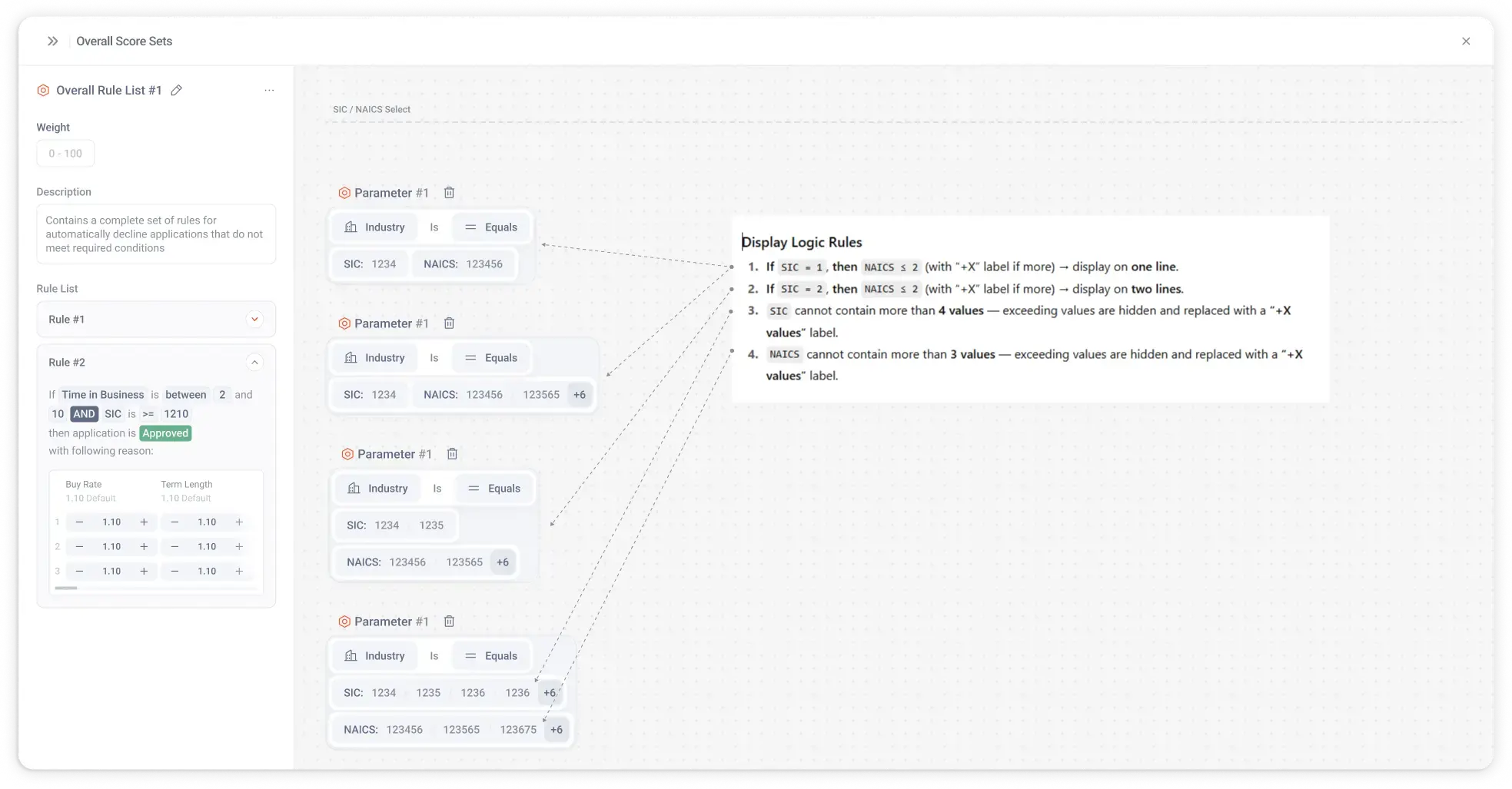
When your head of credit updates an underwriting rule, the update happens verbally or in a spreadsheet. Because there's no version control and no audit trail, there's no guarantee every underwriter applies the change consistently from that point forward. If a deal that funded six months ago is now in default, there's no clean way to confirm which rule set was in place when it was approved.
A CRM assumes the deal is the thing you're tracking. MCA lending software assumes the deal is a live financial asset you're operating, and it manages every step of that asset's lifecycle from the moment it funds to the moment it's paid off.
In practice, that means origination, underwriting, ACH servicing, collections, syndication, and portfolio reporting all run inside the same system on the same deal record. There is no separate ACH portal to log into, spreadsheet to reconcile, or quarterly report your ops manager has to rebuild by hand.
Onyx IQ is built on this model.
When a merchant requests a holdback adjustment, your ops rep updates it inside the deal record, the ACH schedule adjusts automatically and the change is versioned with a timestamp.
When a payment fails overnight, the deal moves to the Payment Issues queue on its own and fires an automated notification to the merchant before your collections rep starts their day, with the full payment history already attached.
When your head of credit updates an underwriting rule, every deal from that point runs against the new standard, and every prior decision has a logged audit trail showing exactly which rule set produced it.
Onyx IQ also connects directly to five ACH processors (ACHWorks, Actum, ACH.com, UZO, and Wells Fargo) and syncs twice daily, so your payment data and deal data are always in the same place.
As a result, your ops rep stops touching the ACH portal for every mid-contract change. Your collections rep stops finding out about failed payments by logging into a separate system the next morning. And your syndicator stops waiting for a spreadsheet that takes your ops manager half a day to assemble.
If you answered yes to three or more, your CRM is no longer covering the full operation. The work is still getting done, but it's getting done manually, across disconnected tools, by your ops team. That's the point where purpose-built MCA lending software pays for itself.
If you’re setting up your first MCA operation and deciding between a CRM and a full lending platform, the decision is simpler than it looks.
Start with a CRM if you’re brokering deals, submitting files to funders, tracking commissions, managing your ISO relationships. You don’t need ACH servicing, syndication logic, or portfolio reporting yet because someone else is running the funded deal. A CRM handles your entire workflow.
Start with purpose-built MCA software if you’re funding your own deals from day one. The moment you fund a deal with your own capital, you have a live financial asset that needs daily ACH management, a payment ledger, collections workflows, and syndicator tracking if you have investors. Building that infrastructure on a CRM and spreadsheets works for the first 20 deals. It creates expensive reconciliation problems at 60.
The practical rule: if money is leaving your account to fund a merchant, you need MCA lending software, not a CRM.
If you’re comparing specific platforms, the side-by-side breakdown is here:
Best MCA Software in 2026: Side-by-Side Comparison of the Top 5 Platforms
With Onyx IQ, your spreadsheet goes away, your separate ACH portal goes away, and if you're running a CRM like HubSpot or Salesforce for ISO and broker relationships, Onyx IQ integrates with it so your sales team keeps working where they already are.
Book a walkthrough with the Onyx IQ team to see what your operation looks like when your collections rep, your head of credit, and your syndicators are all working from the same live data.
Discover how Onyx IQ streamlines Merchant Cash Advance servicing and collections, eliminating manual work and improving efficiency throughout the...
Discover how MCA servicing software streamlines repayment processes, reduces manual workload, and supports growth for businesses managing cash...
Manual handoffs between disconnected tools cost MCA funders time, deals, and RTR. Here's where the gaps open and how to close them.
Like what you're reading?
Make us one of your preferred sources on Google so our content shows up first.