If you're running your MCA operation on a generic CRM, a first-generation MCA platform, or a combination of spreadsheets and bolt-on tools, you've probably asked yourself whether there's a meaningfully better way to run the operation or whether all MCA software is essentially the same thing with a different price tag.
It isn't. Legacy MCA software and a full-cycle lending platform handle the operations that determine how fast you fund, how consistently you underwrite, how accurately you service, how quickly you collect, how cleanly you manage syndication, and how confidently you report to capital partners, in fundamentally different ways.
Read through each dimension, see where your current setup lands, and decide which one fits where your operation is going.
What You're Comparing
Before the comparison, both sides need a clear definition.
Legacy MCA software covers four common setups:
- Standalone or generic CRMs built for sales pipelines and modified to track MCA deals through custom fields and manual workarounds
- Dispersed spreadsheets in Excel or Google Sheets managing pipeline, underwriting, and syndicator splits
- First-generation MCA platforms built for their time but not for the end-to-end automation direct funders at scale now require
- And ad-hoc custom builds, one-off software that depends on the original developer to maintain and can't keep up with regulatory or product changes
What all four share is the same structural limitation: they track deals, but they don't run them. Every time data needs to move between stages, your ops team moves it manually.
On the other hand, a full-cycle lending platform like Onyx IQ runs the entire lifecycle on one deal record. Origination, underwriting, funding, servicing, collections, syndication, and reporting all live in the same system and read from the same data. Your team manages exceptions, not data movement.
Here's how it plays out across the six dimensions that matter most:
#1 — Underwriting Control: Guidelines Your Team Interprets vs. Rules Your System Enforces
On a generic CRM with custom fields and manual guidelines, your credit policy lives in spreadsheet templates, email guidelines, and the institutional knowledge of your most experienced underwriters.
When your head of credit needs to tighten a FICO floor or restrict a high-default industry, the update goes out via team briefing or email. Some underwriters apply it immediately. Others apply it to new deals but not renewals. Some interpret the threshold slightly differently than intended.
Over six months, your portfolio reflects those interpretations more than it reflects your actual credit policy.
Updating the rules requires either a vendor change request, an IT ticket, or a manual briefing cycle, none of which gives you certainty that the new standard is being applied uniformly from the next deal forward.
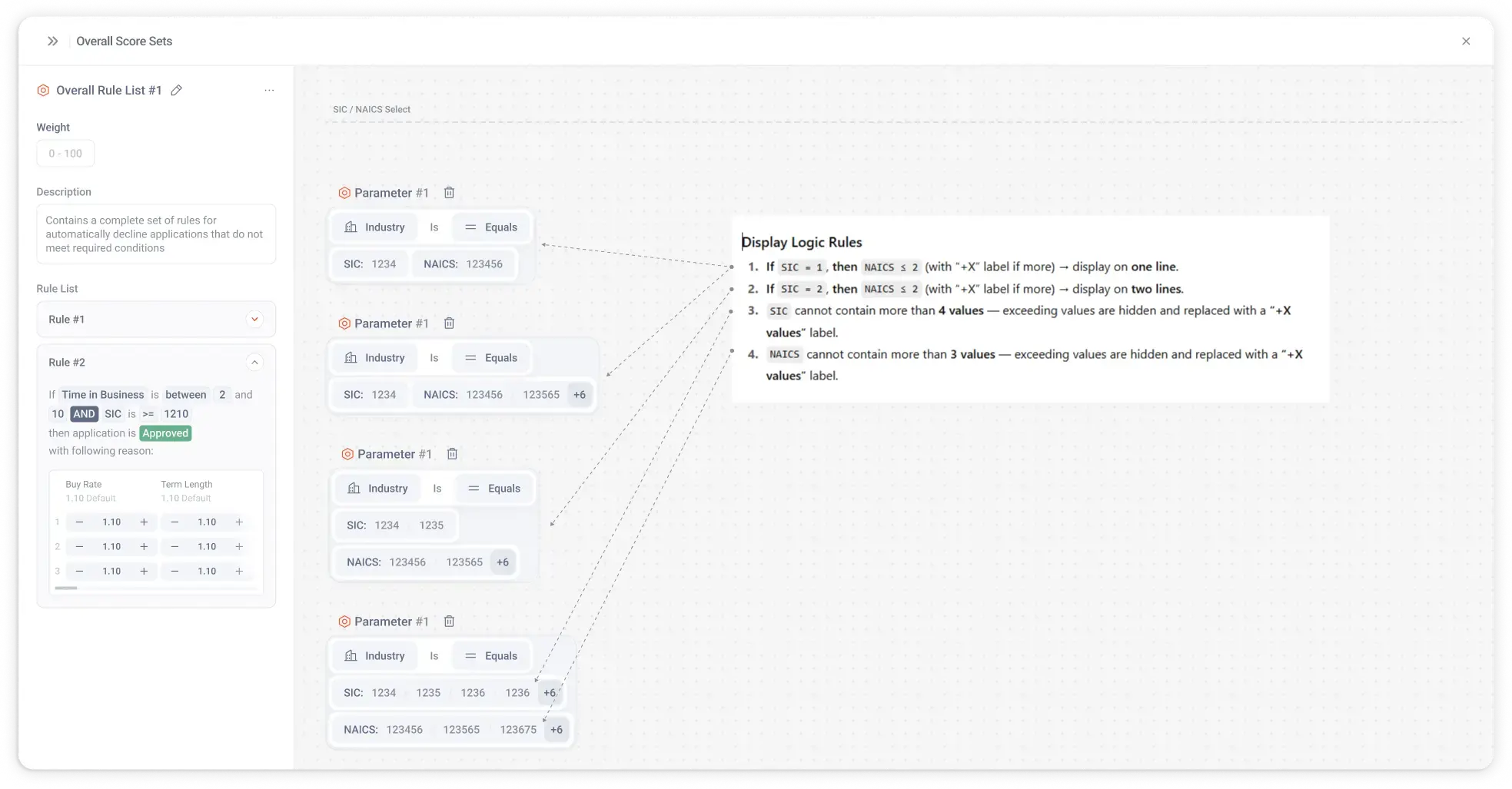
On Onyx IQ, your head of credit builds credit rules directly inside the platform using a no-code scorecard engine. FICO thresholds, time-in-business minimums, industry restrictions, and average monthly deposit requirements become executable logic.
When a deal enters the underwriting queue, the scorecard runs automatically before any analyst opens the file. Clear approvals get an auto-decision. Clear declines trigger an automated ISO notification immediately with no analyst involved. Edge cases route to the queue with the specific flag already surfaced.
When your head of credit needs to update a rule, they make the change inside the platform and it applies to the next incoming application.
Scorecard versioning preserves every previous rule set, so every historical decision is permanently traceable to the exact policy active when it was made.
On legacy software, your credit policy is only as consistent as your team's memory and execution. On Onyx IQ, it's enforced automatically on every deal, at every volume level, with a permanent audit trail.
#2 — File Assembly: Your Underwriters Build the File vs. the Platform Delivers It Ready to Work
On a stitched-together intake stack, a broker submits a file. Your ops team downloads the bank statements, uploads them into a separate analysis tool, pulls a credit report through a different portal, and manually enters application data into the CRM. Your underwriter opens the file and starts building it before they can evaluate it.
A portion of every underwriter's shift goes to intake work that sits upstream of any actual credit judgment.
Adding underwriters without fixing that means you're adding people who spend the same portion of their shift on prep work before they can underwrite.
On Onyx IQ, a broker submits through the ISO portal and OCR scans the attached documents in seconds, automatically extracting business information, stacking positions, and bank statement data directly into the application record. The scorecard runs at intake.
By the time the file reaches your underwriting queue, it's complete, structured, and pre-evaluated. Your underwriter opens it and immediately works it.
Caleigh Toye at Liquify Funding cut underwriting time by roughly 30% after moving to Onyx IQ. The reduction came entirely from removing file-assembly work that had been sitting inside the underwriting function. Her underwriting team didn't change. The work her underwriters were doing before they could underwrite did.

Underwriting, automated
Cut your underwriting time by 30% without adding analysts.
#3 — Servicing Accuracy: Three Systems Your Ops Rep Updates Separately vs. One Change That Propagates Everywhere
On a fragmented stack where your CRM, ACH portal, and syndicator spreadsheet each hold their own copy of the deal, your deal terms live in at least three places.
When a merchant requests a holdback adjustment, your ops rep updates each system separately. Those updates happen independently, which means they fall out of sync.
Your ops team, your collections team, and your syndicators end up working from different versions of the same deal at the same time, and nobody knows it until the month-end reconciliation surfaces the discrepancy.
On Onyx IQ, servicing lives in the same system as origination and underwriting. When a merchant calls to adjust their holdback, your ops rep makes the change once inside the deal record. The ACH schedule updates. The syndicator ledger reflects the new split. The portfolio dashboard reflects the change.
One update, one record, one version of the truth across your entire operation.
On legacy software, data accuracy depends on your ops rep updating multiple systems correctly and in sequence every time. On Onyx IQ, there's only one system to update, so the question of synchronization doesn't exist.
#4 — Collections Response: Manual Portal Checks vs. Automatic Alerts the Moment a Payment Fails
On a setup where ACH processing and collections run in separate systems, an NSF shows up in the ACH portal and stays there until someone on your team logs in and sees it.
Your collections team finds out about payment failures when they next check the portal, on whatever schedule your team has set. The gap between failure and first contact is determined by your team's monitoring schedule, not by the urgency of recovery.
When your collections rep does open the account, the deal context they need is split across multiple systems, none of which is the one they're currently working in.
On Onyx IQ, when a payment fails, the deal automatically moves to the Payment Issues queue.
An automated email and text go to the merchant immediately. Your collections team sees the alert without checking a separate portal, and the recovery workflow starts the moment the failure is logged. When your collections rep opens the account, they see the full deal history inside the same record: underwriting notes, ISO information, complete payment timeline, and syndicator exposure.
On legacy software, your collections response time is a function of how often your team checks a system that should be alerting them. On Onyx IQ, the alert and the context arrive together, automatically, the moment the failure happens.
#5 — Syndication Management: Spreadsheets Your Team Maintains vs. a Portal Your Syndicators Run Themselves
On a spreadsheet-based syndication setup, syndicator participation is tracked in a file your team updates manually after every remittance cycle.
Payout calculations happen outside the system. Syndicators call your ops team to ask about their positions and performance. Discrepancies between your spreadsheet and a syndicator's records require a manual reconciliation to resolve. As your syndication volume grows, the spreadsheet maintenance scales with it.
On Onyx IQ, syndication is a native workflow.
When a deal funds, you add syndicators with their percentage participation and management fees. From that point forward, the system calculates and distributes payouts automatically every time a remittance clears, after deducting your management fees. Your syndicators log into their own portal to see active deals, positions, and performance without contacting your ops team.
When a syndicator wants a monthly report, it generates from the same data that ran the payment waterfall. There's no reconciliation step because there's only one system doing the calculation.
On legacy software, syndication accuracy depends on your team maintaining a spreadsheet that grows more complex with every new capital partner. On Onyx IQ, syndication is automated from the moment a deal funds, and your syndicators self-serve everything your ops team was previously fielding manually.
#6 — Portfolio Reporting: A Build Project Your Finance Team Runs vs. Current Data Available on Demand
On a stack where deal data is split across origination, servicing, and ACH tools, portfolio reporting is a manual assembly process.
When a capital partner asks for a static pool report by vintage, collection curves by deal age, or GAAP-compliant outputs, your finance team exports data from multiple systems, combines it manually, and produces a report that's already a day behind by the time it's finished.
That process tells institutional partners something specific about the maturity of your operational controls. When you're trying to raise a credit facility or formalize a bank sponsor relationship, it's not the picture you want them forming about your operation.
On Onyx IQ, every deal event from origination through final collection runs through the same system and writes to the same record.
Real-time portfolio dashboards show active RTR, syndication RTR, daily payment status, and portfolio concentration without any export or build process. Borrowing base reports, vintage reports, collection curves, and GAAP outputs come out of the platform natively. The data your capital partner reads in a report is the same data your ops team used to fund and service the deal.
Onyx IQ is also SOC 2 Type II certified, which is the compliance certification most institutional capital partners and bank sponsors require before formalizing a relationship.
On legacy software, your reporting quality is capped by how well your finance team can manually reconcile data from disconnected systems. On Onyx IQ, reporting reflects current state because all deal data lives in one place from day one.
Origination, automated
Fund more deals without hiring more people.
The Volume Where the Gap Stops Being Manageable
At 20 deals a week, the manual workarounds in a legacy stack are manageable. Your ops team absorbs the steps, the spreadsheet updates happen on schedule, and month-end reconciliation takes a few hours.
At 60 deals a week, absorbing the same manual steps at higher volume requires more headcount. Your syndicators start calling more often. Your month-end reconciliation runs longer. Your head of credit's policy updates propagate inconsistently because volume pressure leaves less time for briefings.
At 100 deals a week, the manual coordination your legacy stack requires becomes the constraint on your throughput. Your ops cost per deal doesn't decrease as you scale. It stays flat or increases, which means your margin compresses as your volume grows instead of improving.
On a full-cycle platform, that relationship breaks. When there's one system and one deal record, the manual coordination disappears. Your team's capacity grows without proportional headcount increases, your cost per deal comes down as volume increases, and your reporting controls support the institutional capital relationships that open up at higher volume levels.
See the Full MCA Lifecycle Running on One System
Onyx IQ runs the full MCA lifecycle on one connected system: origination, underwriting, funding, syndication, servicing, collections, and portfolio reporting, all on one deal record. There’s no need for handoffs, reconciliation, or spreadsheet updates.
Book a walkthrough with the Onyx IQ team. Bring your current setup to the walkthrough. We'll show you exactly where it's costing you and what changes when it runs on one system.