Summary:
If your operation is small, simple, and still finding its footing, start with point solutions. Don't over-engineer the infrastructure before you've validated the model.
If you're scaling, handoffs are a daily friction, your ops team is doing reconciliations by hand, your syndicators are asking questions you can't answer quickly, and if leadership can't see portfolio performance without building a spreadsheet, a full-cycle platform is the stronger path forward.
The real cost of a fragmented stack isn't the software subscriptions but the headcount covering up the gaps, the errors that compound across systems, and the deals that slow down or fall through because the right information wasn't in the right place at the right time.
How to Choose Between Standalone Lending Tools and a Full-Cycle Lending Platform
Choosing how to build your lending tech stack is one of the most consequential operational decisions you will make. It determines how fast you can fund deals, how cleanly your data flows from origination to collections, and whether your operation holds together when deal volume doubles.
The problem is that most MCA funders and alternative lenders don't choose their tech stack deliberately, they just accumulate it. A CRM here, an underwriting tool there, an ACH processor bolted on the side, and a spreadsheet to track syndication because nothing else handles it. It works until it doesn’t. All of a sudden, when volume grows and you realize the problem is the seams between every individual tool you’ve purchased.
This guide breaks down what you're actually choosing between, where each model works, where each one breaks, and how to decide which path is right for where your operation is headed.
What You're Actually Choosing Between
Before comparing, let's be precise about what each model means because sometimes the terms get used loosely.
Standalone tools (point solutions)
A point solution is software built to do one slice of the lending lifecycle extremely well.
It could be a dedicated underwriting engine, a standalone ACH processor, a collections tool, or an e-signature platform. Each one is optimized for its function, and each one requires you to connect it to everything else.
Point solutions are the default move for most growing lenders because you buy what you need, when you need it, and deal with integration later.
Full-cycle loan management platforms
A full-cycle platform governs the entire lending operation inside one system.
Application intake, underwriting, contracts, funding, ACH servicing, collections, syndication, and portfolio reporting all live in the same data model. When a deal moves from underwriting to funding, nothing gets re-entered. When a payment fails, the system already knows the deal history, the underwriting notes, and the syndication exposure.
Onyx IQ is a full-cycle lending platform built specifically for MCA funders and alternative lenders. We'll use it as the reference point throughout this comparison.
But full disclosure, neither model is universally better. The right choice depends on where your operation is today and where it's going.
Here's how to think about it:
How a Deal Moves Through Your Operation
Lending isn't a set of isolated functions, it is a sequence, and every step depends on the one before it. Let’s walk through a single deal in your operation right now:
- A broker submits an application. Does it land in one system, or does someone have to move it manually?
- Your underwriter reviews it. Are the documents, credit data, and ISO history already there, or does someone pull them from three places?
- The deal gets approved. Does the approval automatically generate the contract, or does someone re-enter the terms?
- The deal funds. Does servicing pick up the repayment schedule automatically, or is there a handoff email?
- A daily ACH fails. Does your collections team know immediately, or do they find out three days later?
- Month-end arrives. Does your syndication report build itself, or does someone spend two days in Excel?
Every "or does someone" in that list is a seam. Each seam is a place where data gets re-entered, errors compound, and your team burns hours on work that should be automatic.
The choice between point solutions and a full-cycle platform is really a choice about how many seams you're willing to manage and at what volume they become unsustainable.
Where Standalone Tools Work Well for Lenders
Most alternative lenders start with point solutions by necessity. Here's when that approach holds, and when it stops working.
You have one specific, isolated problem
If your underwriting is the bottleneck and everything else runs fine, buying a dedicated underwriting tool makes sense. You don't need to overhaul your entire operation to fix one workflow. Deploy the tool, solve the problem, move on.
You're early-stage and still finding product-market fit
When you're at 10 deals a month, the seams are manageable. Your team is small enough to work around them. A full-cycle platform implementation at that stage adds overhead you don't need yet. Start lean, prove the model, then build the infrastructure.
Your team has strong technical resources
Point-solution stacks can work well but only if you have someone who owns the integrations, manages the API connections, and governs the data model across systems. If you have that person, you can build a clean modular stack. If you don't, it becomes a mess at scale.
You need specialized depth in one specific function
A dedicated collections platform may offer more sophisticated queue logic, outbound dialer capabilities, and recovery analytics than a full-cycle platform's collections module. If one function is your core competitive edge and requires genuine specialization, a point solution can be worth the integration cost.
Where Point Solutions Break Down
The problems with a fragmented stack don't show up on day one. Here's what actually happens as your operation scales.
Your CRM shows one deal status but your underwriting tool shows another. Your servicing platform has the payment history but your collections inbox has the notes and your syndication spreadsheet tracks exposure by investor. None of these systems were built to talk to each other, and the reconciliation work falls on your team every day.
At 50 deals a month, your ops manager handles it manually. At 200 deals a month, you've hired two people whose entire job is reconciling data across systems. You’re paying people to cover up a broken architecture.
Manual handoffs between systems create errors
The moment a deal crosses from one system to another, anything can go wrong. Terms can get re-entered incorrectly, a document may not follow the file, a status update may not sync, and some payment history may not transfer. These are mistakes that happen when 5 tools are sharing a workflow they weren't built to share.
Portfolio reporting becomes a manual project
Every lender wants visibility into portfolio performance. With a fragmented stack, getting it means pulling exports from multiple systems, cleaning and normalizing the data, reconciling conflicting definitions, and building reports manually, often in a spreadsheet someone updates by hand each week.
If you have capital partners or syndicators, this can become a credibility problem. Investors expect consistent, timely reporting, and a monthly spreadsheet compiled by hand doesn't inspire confidence.
Your collections team works without full account context
When a payment fails and your collections manager opens the account, what do they see? If your collections tool is disconnected from your underwriting platform, they see payment history and nothing else. They don't know what the underwriter noted about the merchant's risk profile, the ISO's history, or which investors have syndication exposure on this deal.
Context is what makes collections effective. Without it, your team is making recovery decisions in the dark.
Integration costs add up over time
Every tool you add creates a dependency. For example, when one vendor updates their API, a downstream workflow can break. When one system's status field doesn't map cleanly to another, your ops team invents a workaround and that workaround becomes load-bearing infrastructure that nobody documents.
The stack that seemed manageable at launch becomes something only one person understands, and that person is your single point of failure.
Where Full-Cycle Loan Management Platforms Like Onyx IQ Work Well
A full-cycle platform is a different operating bet. You're not optimizing individual departments, you're optimizing the entire lending operation as one connected system. Here's what that actually changes:
One system of record eliminates daily reconciliation
Data is entered once. When a deal moves from underwriting to funding, the terms, bank data, and ISO information automatically populate servicing and ACH tracking. When a payment is processed, the portfolio dashboard updates in real time. There's no "which system is right?" problem because there's only one system.
For operators running 100+ deals a month, this is what makes scaling without proportional headcount growth actually possible.
Every stage of the deal inherits context from the last
In Onyx IQ:
- Origination feeds directly into underwriting
- Underwriting decisions flow into contract terms.
- Contracts flow into servicing setup. Servicing data triggers collections workflows.
- Collections outcomes feed portfolio reporting.
And each stage inherits the full context of the stage before it without anyone moving a file, sending an email, or re-entering a data field.
When a daily ACH debit fails, the system can immediately flag the account, trigger automated soft-collections communications, and update the portfolio dashboard, all without anyone manually connecting the dots.
Your collections team has full deal context
When your collections manager opens a delinquent account, they see the complete picture: the original underwriting notes, the ISO's history, the payment timeline, the syndication exposure, and every prior communication in one place. That context changes how they work. They're not making blind outreach calls anymore, now they're making informed recovery decisions based on the full file.
Syndication becomes a managed process, not a spreadsheet
For MCA funders operating with syndicate capital, disconnected systems create serious reporting friction.
Onyx IQ includes native syndication management (automated payout calculations, investor portals with real-time position visibility, and participation tracking) built into the same system that runs origination, servicing, and collections.
When a payment is processed, syndicator balances update automatically. When an investor wants to see their exposure, they log into the portal. They don't wait for you to compile a report.
You can grow deal volume without growing headcount at the same rate
This is the core operational argument for a full-cycle platform.
When intake, underwriting, contracts, funding, servicing, collections, syndication, and reporting all run in one system, you're not adding manual coordination work every time you add a deal. The workflows scale because they're automated, which allows your team to handle more volume with the same infrastructure.
Launching a new product doesn't require a multi-vendor project
When your underwriting rules, contract templates, servicing logic, and reporting layer all live in one system, rolling out a new lending product means updating one configuration, not re-testing and re-syncing four separate tools.
In a fragmented stack, every product change triggers a coordination project across vendors. One system updates before the others are ready, edge cases fall through the gaps, and your ops team spends weeks validating that the handoffs still work.
In a full-cycle platform, you update your scorecard, adjust your servicing rules, and the change propagates across the entire lifecycle automatically.
Your whole team operates from one interface
In a point-solution stack, your underwriter logs into one system, your ops rep logs into another, your collections manager logs into a third. Each tool has its own interface, its own terminology, its own version of the deal record. Training new staff means learning three or four systems instead of one.
In Onyx IQ, your underwriter, ops rep, collections manager, and finance lead all work from the same interface—the same deal record, the same status fields, the same data. When a question comes up about a specific account, everyone is looking at the same thing. There's no reconciling what one system says against what another shows.
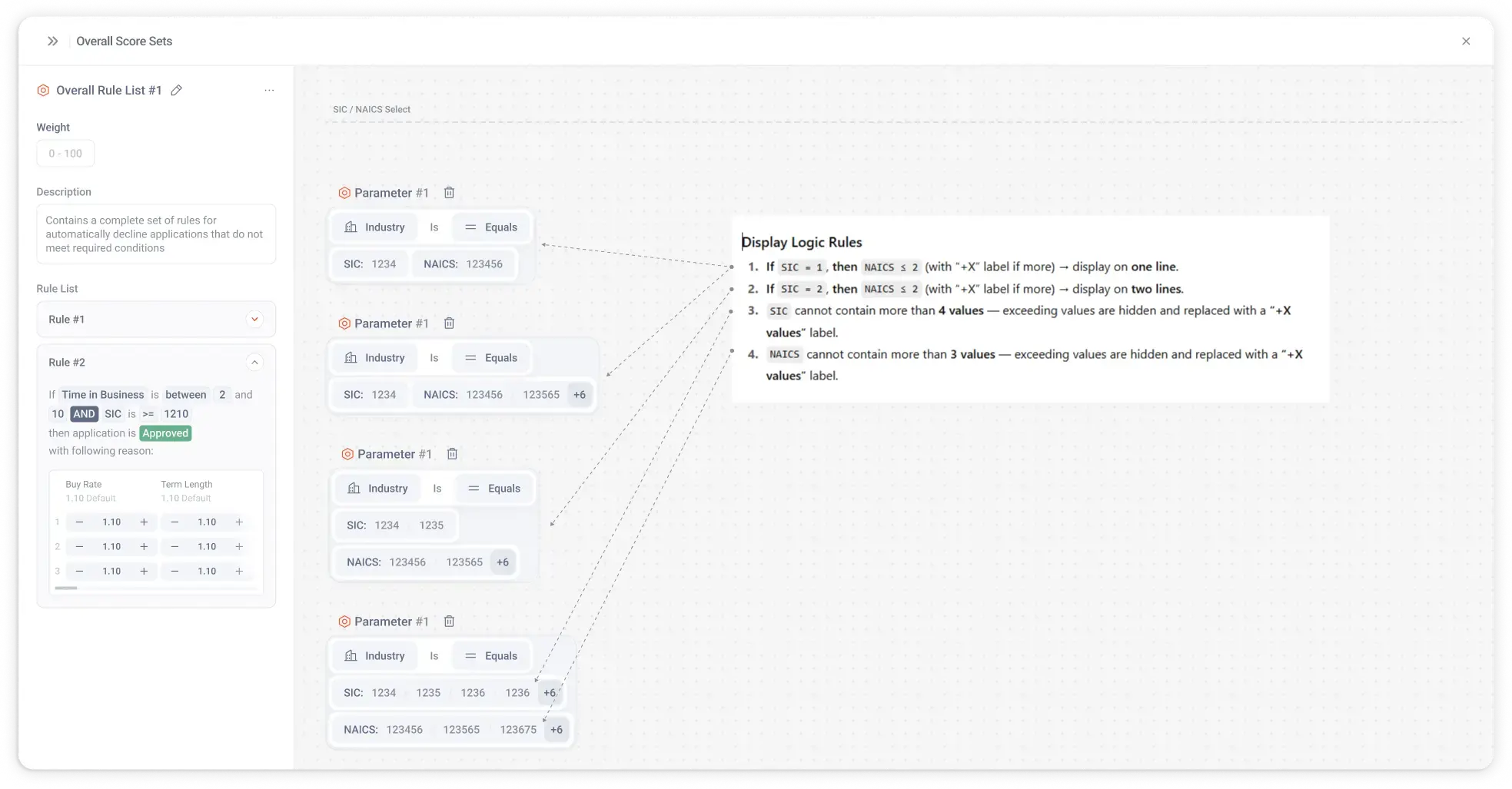
Your ops team can change underwriting rules without filing a ticket
In a fragmented stack, changing a credit rule means coordinating with multiple vendors — updating the logic in your underwriting tool, making sure the output still maps correctly to your LOS, verifying the servicing setup still matches the new terms. It's an IT project every time your head of credit wants to tighten a policy.
In Onyx IQ, your credit team updates scorecard rules directly through a no-code interface. There’s no need for dev work, vendor tickets, or multi-system re-testing. The updated logic deploys immediately and applies to every new deal that moves through the platform: underwriting, contracts, servicing, and reporting all reflect the change automatically.
Where Full-Cycle Deal Management Platforms Fall Short
A fair comparison means being honest about the trade-offs, and full-cycle platforms aren't the right fit for every operation.
Implementation requires commitment upfront
Deploying a full-cycle platform touches more workflows, teams, and data than plugging in a single tool.
You need to define your deal statuses, approval workflows, scorecard logic, servicing rules, collections stages, and reporting requirements before you go live. If you treat it like a plug-in rather than an operating model change, you'll have a bad time.
Some modules won't match a dedicated specialist tool
A full-cycle platform handles collections well, but it may not have the same outbound dialer depth as a platform built exclusively for enterprise debt collections. Its fraud detection will be solid, but it may not match a dedicated fraud intelligence tool with proprietary data networks. If any one function is your primary competitive edge, evaluate the platform's specific module carefully before assuming it meets your bar.
Vendor dependency is real, vet accordingly
When one platform runs your entire lending operation, that vendor becomes strategically important. If their support weakens, their roadmap diverges from your needs, or they experience a serious outage, more of your operation is affected than with a distributed stack. Vet the vendor thoroughly, not just the product.
Ask about data portability, SLAs, implementation support, and what a migration looks like if you ever need one.
How the Two Models Compare Side by Side
Here's how standalone tools and full-cycle loan management platforms stack up across the dimensions that matter most for MCA funders and alternative lenders.
How to Choose: A Decision Framework for MCA Funders
Here's a direct framework. Work through these two checklists and the right path becomes clear.
Choose standalone tools if most of these apply to your operation:
- You're very early-stage or still validating your lending model.
- Your current pain is isolated to one specific workflow.
- You have a dedicated internal team that owns and manages integrations.
- You need specialized depth in one area that no platform module matches.
- Your deal volume is low enough that manual handoffs are still manageable.
- Your reporting requirements are simple and entirely internal.
Choose a full-cycle platform if most of these apply to your operation
- You're scaling volume and the seams in your current stack are showing.
- Your team spends meaningful time on data reconciliation, handoff coordination, or manual reporting.
- Your collections team lacks account context when working a delinquent deal.
- You have syndication or investor reporting requirements that a spreadsheet can no longer support.
- Leadership can't see portfolio performance without manually building a report.
- You want to grow deal volume without growing headcount at the same rate.
- You need a clean, centralized audit trail for compliance or investor scrutiny.
The Hybrid Approach: When You Need Both
The strongest tech architecture for some lending operations isn't all-or-nothing. It's a full-cycle platform as the operational system of record, with specialized tools layered in only where they create a clear competitive advantage.
Use the platform for your core deal record: origination, underwriting, servicing, collections, syndication, and reporting. Add specialized tools at the edges where they clearly outperform the platform's native module: a bank-statement analysis provider, a dedicated fraud intelligence feed, an advanced BI layer if your reporting needs outgrow what the platform ships.
This avoids the worst version of both models. You're not running a fragmented patchwork of tools that don't talk to each other. And you're not locked into a platform's defaults for every function. You get centralized control with selective flexibility where it actually matters.
See How Onyx IQ Runs The Full Lending Lifecycle In One Place
Onyx IQ is a full-cycle lending platform built specifically for MCA funders and alternative lenders. Origination, underwriting, ACH servicing, collections, syndication, and portfolio reporting is one system, as one source of truth.
Book an Onyx IQ walkthrough here.
Frequently Asked Questions
What is the difference between a loan origination system (LOS) and a full-cycle lending platform?
A loan origination system handles the front end of a deal — application intake, underwriting, and approval. It stops at funding. A full-cycle lending platform covers the entire lifecycle: origination, underwriting, contracts, funding, ACH servicing, collections, syndication, and portfolio reporting in one system. MCA funders typically need the full lifecycle covered. An LOS forces you to add 3 to 4 additional tools to run a complete operation, which is where the integration problems start.
How do I know when my operation has outgrown point solutions?
The clearest signals: your ops team is doing manual reconciliations daily, deals are slowing down at handoff points between systems, your portfolio reporting takes days to compile, your collections team doesn't have full account context, or your syndicators are waiting on reports you're building by hand. Any one of these individually is a warning sign. If you're experiencing two or more at the same time, you've outgrown your current stack.
How long does it take to implement a full-cycle lending platform?
For MCA-native platforms with pre-built workflows, implementation typically runs 4 to 8 weeks. The timeline depends on how much data you're migrating from legacy systems, how many deal statuses and workflow rules you need to configure, and whether you're running both old and new systems in parallel during cutover. Budget for a parallel run period of 4 to 8 weeks where your old system continues to service funded deals while the new platform handles new originations.
Can I migrate to a full-cycle platform without disrupting deals already in my portfolio?
Yes. Most MCA platform migrations run a parallel period where the legacy system continues servicing funded deals while the new platform handles all new originations. Funded deals migrate to the new system as they pay off or renew. The risk isn't disruption to existing deals, it's the parallel-run period itself, where your team is operating two systems simultaneously. That's why implementation planning and data migration strategy matter as much as the platform you choose.
What should I look for in a full-cycle platform if I syndicate deals?
Native syndication support, not a bolt-on. You want automated payout calculations, a real-time investor portal where capital partners can see their positions without asking you, and participation tracking that updates automatically when payments are processed. If syndication is handled through a separate tool or a manual spreadsheet layer, you've reintroduced the exact fragmentation you were trying to eliminate. Verify that the platform handles your specific syndication structure (waterfall logic, split percentages, and investor-level reporting) before you commit.
Is a full-cycle platform the same as an all-in-one or integrated lending platform?
The terms are often used interchangeably, but there's a meaningful difference in practice. All-in-one can mean a platform that bundles many tools without actually integrating the underlying data model. A true full-cycle platform shares one data model across every stage, so origination, underwriting, servicing, collections, and reporting all operate on the same deal record. When evaluating vendors, ask specifically: is this one database or multiple modules that sync? The answer tells you how clean the handoffs actually are.
Does switching to a full-cycle platform mean replacing everything we use?
Not necessarily. Most mature lending operations use a full-cycle platform as the operational backbone and integrate specialized tools at the edges: a bank-statement analysis provider, a fraud detection feed, an e-signature tool, or an advanced BI layer. You're not choosing between one platform and all your existing tools. You're choosing what becomes the system of record for your core deal data, and what gets connected to it. Start there, then evaluate which current tools you keep and which you consolidate into the platform.