Merchant Cash Advance (MCA)
Where MCA Deals Break: The Operational Gaps Between Your Tools
Manual handoffs between disconnected tools cost MCA funders time, deals, and RTR. Here's where the gaps open and how to close them.
Servicing is one of the first parts of an MCA operation to get harder as volume grows.
Origination usually gets more attention because that's where deals are sourced, underwritten, and funded. But once the wire goes out, your team still has to manage the whole repayment side of the deal. That means running daily or weekly ACH, tracking each remittance against the remaining RTR, managing failed pulls and NSFs, keeping syndicator positions current, handling payoffs and renewals, and knowing which merchants need attention.
When you are carrying a small book, spreadsheets and processor portals can usually handle the workload, but as you move into hundreds of active positions, the amount of manual servicing work grows quickly. Your team spends more time reconciling payments, updating balances, checking exceptions, and keeping syndication records straight.
At that point, servicing starts to limit how much you can fund with the team you already have. That's the reason MCA servicing software exists. It gives you a system built to carry more of the day-to-day servicing work so you can grow the book without growing servicing headcount at the same rate.
MCA servicing software manages what happens after a deal funds. That includes setting up the payment plan, running daily or weekly ACH, tracking failed pulls, updating remaining RTR, calculating syndicator splits, handling payoffs, and carrying the deal through renewal.
In other words, it's the system of record for the servicing side of your book.
You are already doing this work today, whether it lives in a spreadsheet, a processor portal, or in the heads of the people on your ops team. What the servicing software changes is how much of that work your team has to touch manually.
Instead of your team starting debits, checking which payments cleared, updating balances, and reconciling syndicator positions by hand, the platform keeps that activity tied to the deal record and automates the routine work.
That becomes more important as the book grows, because servicing gets harder as your team manages more active positions at the same time.
If you are funding merchang cash advances, you already have a servicing process. The real difference is whether that process depends on people and spreadsheets or whether you have a system that can carry the workload as active deal count grows.
The warning signs usually show up in the day-to-day work first.
Maybe your team is spending hours reconciling ACH activity, updating remaining RTR, checking failed pulls, and calculating syndicator splits. The work still gets done, but every new batch of funded deals adds more manual servicing on top of it.
Or maybe you are an ISO moving from brokering into direct funding. Once you put your own capital into deals, you also take on the repayment side: payment schedules, collections, reconciliation, renewals, payoffs, and syndicator reporting.
You may also already have software in place, but it was built around term loans. In that case, your team ends up working around the system whenever it does not handle daily ACH, RTR, renewals, or syndication the way your book requires.
The real trigger
The tipping point is usually driven more by active deal count than by total dollars funded.
A funder with 20 large advances may be able to stay on a spreadsheet longer than a funder with 400 smaller positions. The second shop has far more payment schedules, ACH attempts, exceptions, RTR balances, and syndicator allocations to keep straight every day.
That is what puts pressure on a manual servicing process.
Once your active book is growing faster than your team can comfortably manage it, servicing starts to limit how much you can fund next. That is usually the clearest sign that the process needs to move out of spreadsheets and into a system built for MCA volume.
A lot of lending software was originally built to service term loans and later adapted for MCA and other forms of alternative lending. The problem is that the system still handles balances, payments, and deal history based on how a traditional loan works.
A term loan is relatively predictable from a servicing standpoint. Principal, interest, payment amount, and amortization schedule are set up at origination, and the balance works its way down over time.
A cash advance behaves differently. You are tracking an advance amount and factor rate, collecting daily or weekly remittances, watching the remaining RTR change as payments come in, and often renewing merchants before the original position is fully paid off. If you syndicate deals, every remittance also has to update multiple positions correctly.
A loan platform can usually be configured to handle pieces of that workflow. The problems start when your team has to keep working around the parts the system was never designed to handle.
You can try to make loan software work for advances, but your team will end up filling the gaps with spreadsheets, manual calculations, and side processes outside the platform. Over time, those extra records become another thing to reconcile and another place for the numbers to drift.
As volume grows, that manual work grows with it. And once your team is doing more work just to make the software fit the book, the platform is no longer helping you scale the way it should.
Once you know you need software built for advances, there is another choice to make: do you want a standalone servicing tool, or a platform that handles the full deal lifecycle from underwriting through payoff?
The difference comes down to how much work your team has to do between systems.
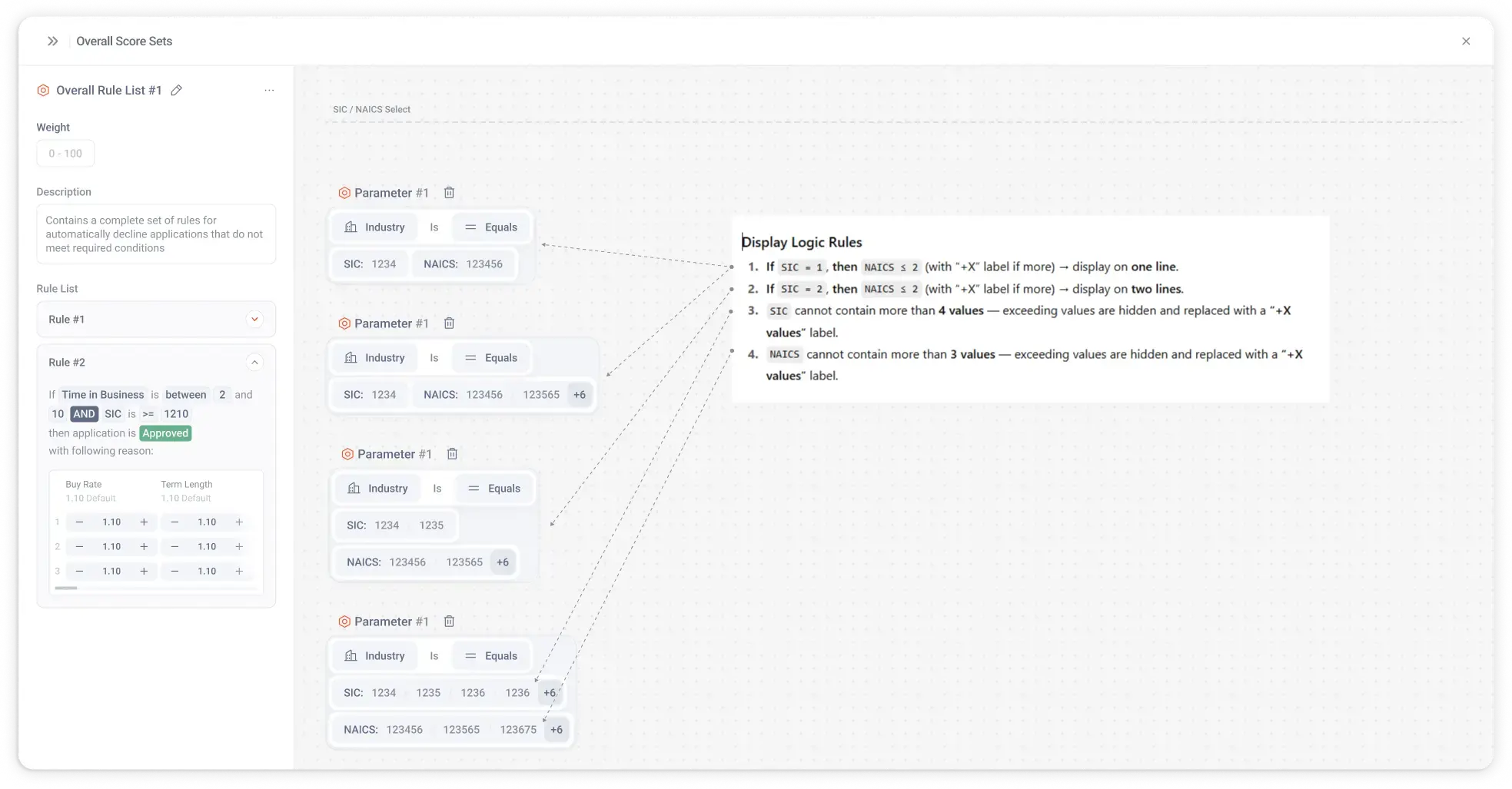
With a disconnected stack, you might use one tool for decisioning, another for servicing, and a spreadsheet for syndication. When a deal gets approved, your team has to move the deal data into servicing. Once it funds, the payment plan may need to be set up separately. If the deal is syndicated, the participation percentages and remittance splits may live in a separate spreadsheet.
The issue with that setup is that every handoff creates another place where your team has to re-enter data, check that two systems agree, or fix an entry that did not carry over correctly.
That gets especially painful at month-end. Your team may be pulling funding data from one system, ACH and RTR data from another, and syndicator balances from a spreadsheet, then reconciling them by hand before the numbers are usable.
As volume grows, those handoffs grow with it.
An end-to-end platform handles that differently because the deal stays on the same record as it moves through the lifecycle. The deal you underwrite is the deal you fund. Once it funds, the servicing plan carries forward. ACH activity, remaining RTR, renewals, payoffs, and syndicator positions stay connected to that same record.
That means your team spends less time re-keying information and reconciling systems that were never designed to stay in sync.
A standalone servicing tool can still make sense, especially if the rest of your stack is working well and you only need to replace the servicing layer. But you should account for the work that still has to happen between that tool and the rest of your stack.
For a growing funder, that is the real tradeoff. The more systems your team has to connect manually, the more operational work you add as deal count climbs. A platform that carries the same deal record from origination through servicing removes more of those handoffs, which makes it easier to grow the book without adding people just to keep the systems aligned.
The main reason to automate servicing is simple: you want to add more deals without adding servicing headcount at the same pace.
As your active book grows, the routine work grows with it. There are more ACH pulls to run, more failed payments to catch, more RTR balances to keep current, and more syndicator positions to reconcile. If your team is handling most of that by hand, every increase in deal count creates more work.
Servicing software takes the repeatable parts off your team's plate so they can focus on the deals that actually need attention.
It keeps scheduled payments moving. Once a deal is funded, daily or weekly ACH runs according to the payment plan without anyone manually starting debits every morning. Your ops team can spend that time working NSFs, payment issues, and other exceptions instead.
It catches problems faster. When a debit fails, your team can see it right away instead of finding it later during reconciliation. That gives them a better chance to work the account while the issue is still fresh and before missed payments start stacking up.
It gives your team one live view of the book. Instead of checking a processor portal for ACH activity, a spreadsheet for RTR, and email threads for merchant updates, your team can work from the same servicing record. That makes it much easier to see what cleared, what failed, what is still outstanding, and what needs attention.
It gives you better oversight as you automate more. The routine work may happen automatically, but the activity still needs to be visible. Payments, plan changes, failed pulls, renewals, and merchant activity should all be recorded in the same place. That gives your team a cleaner history to work from and makes it easier to answer questions from compliance, auditors, management, or syndicators.
The practical benefit is that your team can manage a larger active book without the servicing workload growing at the same rate.
That is also what to look for when you compare platforms. The useful question is not how many features they say they automate. It is how much day-to-day servicing work still lands back on your team once the book gets busy.
If you are servicing out of spreadsheets or constantly working around a loan platform that was never built for advances, start by looking at where your team is spending time today.
Those are the places where your current process is starting to cap how much volume the team can handle.
Once you know where the manual work is piling up, you can evaluate servicing software against a much clearer question: how much of that work will the platform actually remove?
Manual handoffs between disconnected tools cost MCA funders time, deals, and RTR. Here's where the gaps open and how to close them.
Hiring to add MCA volume just grows payroll. See where manual work caps your team and the automations that let the same people fund more deals.
Discover how purpose-built MCA software streamlines operations beyond CRM capabilities, ensuring efficiency and accuracy in managing funded deals.
Like what you're reading?
Make us one of your preferred sources on Google so our content shows up first.