Good MCA software should help you fund more deals with less manual work.
If you're funding at any real volume, you probably already have a platform in place. So when you see a list like this, it is easy to assume it is for funders still running everything in spreadsheets.
But having a platform and having the right platform are two different things, and the wrong one can cost you money for a long time before you notice. The wrong system can slow down approvals, force your team into manual work, and let money slip through the cracks for months before the cost becomes obvious.
At first, it looks small: a deal that took too long to approve, a report someone had to rebuild by hand, a renewal nobody followed up on. But across dozens or hundreds of deals, those small problems turn into lost revenue, higher operating costs, and losses you could have avoided.
Here are 7 signs your current MCA software is already costing you money, where that cost comes from, and what changes when you move to a platform that can run the full deal lifecycle. If two or more sound familiar, keeping your current system may already be costing you more than replacing it.
1. Your software still leaves your team doing manual data entry
A deal comes in, and even with a system in place, someone still has to key the application in and work through the bank statements before you can make an offer. Maybe your current software captures part of it, but your team fills in what it missed, checks the positions, and cleans up the data by hand.
That leaves you with the same problem as having no software at all: every deal waits on a person. In MCA, speed decides who wins, because merchants are usually talking to several funders at once. If another funder gets a solid offer out first, they have a much better chance of closing the deal. So the slower your intake runs, the more good deals you hand to the competition.
Manual intake also makes growth more expensive. The more deals you take on, the more people you need to process them, which raises your cost on every deal you fund.
What CHANGES WITH THE RIGHT MCA SOFTWARE
When the software handles intake automatically, your team can review deals and send offers much faster. The system reads the application and bank statements, then pulls out the business information, deposits, and stacked positions your team needs to make a decision.
That means you can get good offers in front of merchants sooner and win more of the deals you were losing on speed. And because your team can process more applications without adding more people, you can grow your funded volume without growing your operating costs at the same rate.
We go deeper on how this works in our guide to MCA servicing software.
2. Your software can't keep up with new disclosure laws
Manual intake slows your team down every day, but a disclosure your software gets wrong can cost you much more in one shot.
Commercial financing disclosure rules vary by state, and those rules keep changing. If the software you have can't generate the right disclosure on its own and keep it current, your team is back to checking the requirements and editing contracts by hand on every deal, no matter what you're paying for that system.
That creates two expensive risks:
First, if the disclosure is wrong or incomplete, you can run into problems enforcing the agreement when a merchant stops paying, which makes it harder to recover money you were counting on.
Second, a disclosure mistake can put you on the hook for regulatory penalties.
And even when your team gets it right by hand, that manual check slows every deal down, so you lose deals on speed while you carry the risk.
What CHANGES WITH THE RIGHT MCA SOFTWARE
When your software generates the correct disclosure automatically based on the deal and the merchant's state, your team can keep deals moving without stopping to check requirements or edit documents by hand.
That helps you fund faster across every state you operate in, while reducing the risk of disclosure mistakes, regulatory penalties, and collection problems later.
As the rules change, the platform stays current, so your team doesn't have to keep tracking every update themselves.
3. Your software can't handle syndication, so you're stuck in spreadsheets
A lot of MCA platforms handle the basics but stop short of real syndication. So even with software in place, you're still tracking shares, payouts, and fees in a spreadsheet off to the side.
Once you're syndicating, you're managing other people's money next to your own, which means every share, payout, and fee has to be right. In a spreadsheet, that gets risky fast. One bad formula or one outdated cell changes what a partner is owed, and then your team has to find the mistake, fix the numbers, and explain the gap.
Those mistakes turn into disputes, but there's a bigger problem too: your partners want to see where their money stands. If they have to wait for your team to send an updated spreadsheet every time they ask, they lose visibility into their positions, payouts, and returns. And when partners stop trusting the numbers, they get slower to put more capital into your deals.
That caps how much you can fund, because you're back to deploying mostly your own money.
What CHANGES WITH THE RIGHT MCA SOFTWARE
When syndication runs inside the same platform as the deal, every partner's position, share, payout, and fee updates automatically as payments come in.
In Onyx IQ, your partners can log in and see their numbers for themselves, so they don't have to wait for your team to build or send another spreadsheet.
That gives partners more confidence in the operation, reduces the time your team spends fixing numbers and answering questions, and makes it easier to keep outside capital available for new deals. As a result, you can deploy more capital without relying only on your own money to fund growth.
| Free guide Ready to run your lending shop without spreadsheets? See how MCA funders move their whole deal lifecycle onto one platform. Start here. |
Get the guide |
4. Your software has no scorecards or rules engine
Some MCA systems store your deals but can't actually make a decision on them. If your software has no scorecard or rules engine, every application still gets underwritten from scratch, and that costs you on both ends.
First, your good deals take too long to approve. While an underwriter works through the file by hand, another funder may already be sending the merchant an offer, and you can lose a strong deal just because someone else decided faster.
Second, without consistent rules, decisions drift from one underwriter to the next. A weak deal that one person would decline gets approved by someone else, which raises your defaults and your losses.
So manual underwriting hurts you both ways. You lose good deals by moving too slowly, and you take on bad deals because your credit calls aren't consistent.
What CHANGES WITH THE RIGHT MCA SOFTWARE
With scorecards and underwriting rules in place, the system can handle the obvious decisions automatically.
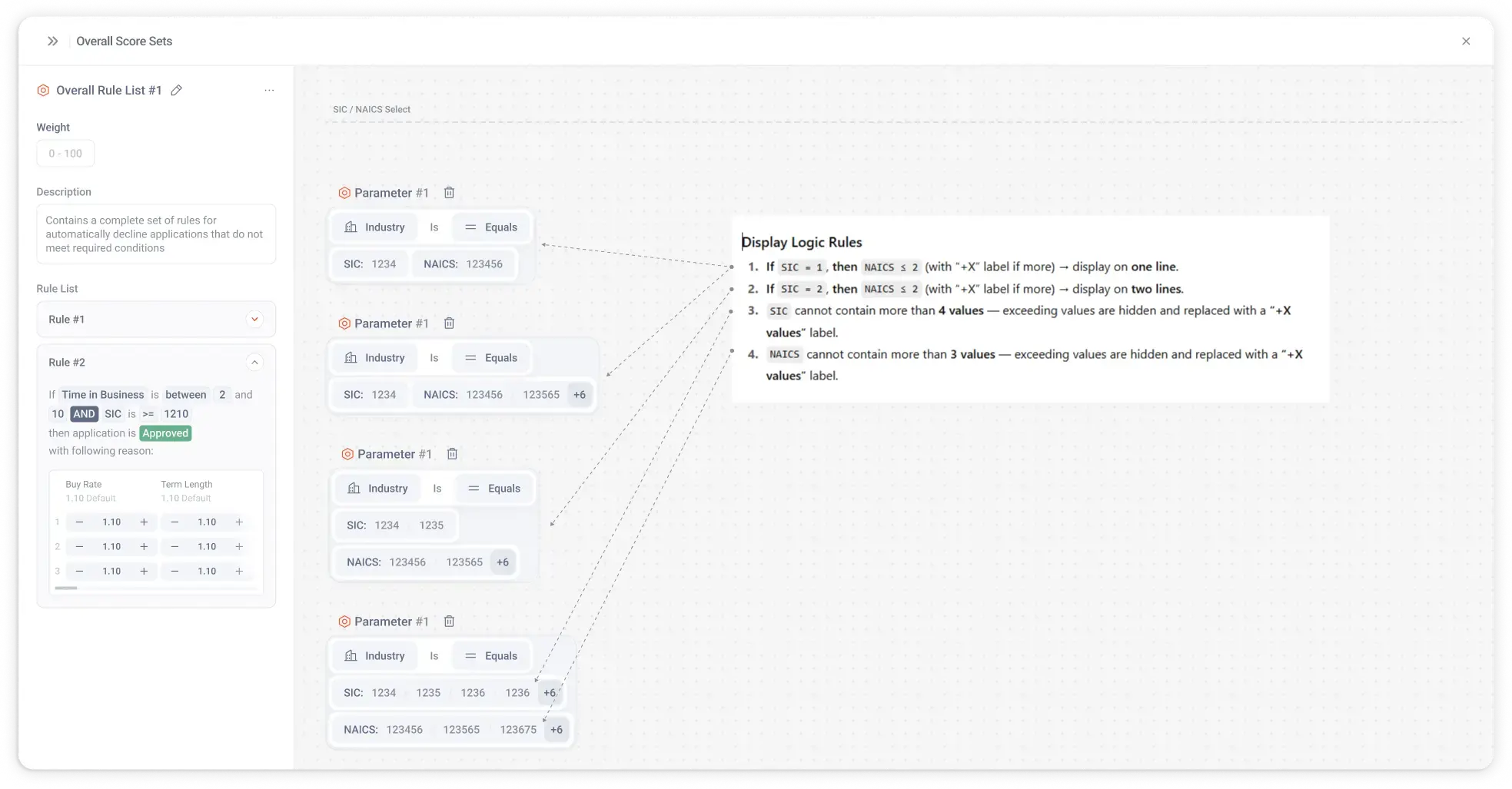
Strong deals that meet your criteria can move through the process faster. In Onyx IQ, deals that clearly fall outside your credit policy can be declined or flagged before an underwriter spends time on them. Your team can then focus its attention on the deals that actually need judgment.
That helps you send offers faster, keep weak deals out of your portfolio, and process more applications without adding more underwriters. And because your credit team can update the scorecards and rules themselves, they can adjust your underwriting criteria as your strategy changes without waiting on a developer.
5. You can't produce the reports your capital partners ask for
Good underwriting helps you pick better deals, but to keep funding them, your capital partners have to stay confident in how you run the operation, and that confidence runs on reporting.
When a credit facility or an investor asks for a static pool report, month-end numbers, or an update on portfolio performance, they expect a clear answer fast. If the software you have can't produce that reporting cleanly, your team pulls data from a few places, rebuilds the report by hand, and double-checks it before sending. Every request turns slower and harder than it should be.
And when reports show up late, incomplete, or inconsistent, partners start asking harder questions about how tightly the book is managed.
That hits you in real dollars. A lender may hold off on raising your line, an investor may deploy less capital, or your cost of capital may go up. When your whole business depends on having capital to fund new deals, weak reporting turns into a growth problem quickly.
What CHANGES WITH THE RIGHT MCA SOFTWARE
When your reporting comes directly from the same system that runs your portfolio, your team can answer capital partners much faster.
In Onyx IQ, static pool, collection-code, and month-end reports stay ready to pull, while metrics such as Active RTR, Syndication RTR, and Total RTR stay current as the portfolio changes. So when a facility or investor asks how the book is performing, your team can give them clear numbers without rebuilding the report from scratch.
That makes it easier for capital partners to understand what's happening in the portfolio, gives them more confidence in your operation, and puts you in a stronger position when you need more capital to keep funding.
6. You're running your operation across too many disconnected tools
Weak reporting is usually a symptom of a bigger problem: your main software only covers only part of the deal. It runs origination, so you bolt on another tool for reading statements, a spreadsheet for syndication, something else for reporting, and a separate tool for collections.
Each of those is its own subscription, so your software spend climbs as the stack grows. But the bigger cost is what happens between them. Your team enters the same deal into two or three systems, the numbers don't always match from one to the next, and someone has to reconcile them by hand.
Because those tools were never built to work together, information gets stuck in one place instead of moving with the deal. That slows your team down, creates errors, and makes it hard to get one clean view of your book at any moment.
So the more you grow, the more tools you add, and the more time and money you spend just keeping them in sync.
What CHANGES WITH THE RIGHT MCA SOFTWARE
When origination, underwriting, syndication, servicing, and collections all run in one platform, your team works from a single record instead of moving data between tools.
With end-to-end MCA software like Onyx IQ, you replace a stack of separate systems with one, so there's less software to manage and far less manual work spent reconciling numbers and re-entering the same deal. Information moves with the deal from application through payoff or renewal, so everyone is looking at the same picture.
That keeps your operation simpler and faster as you scale, because you're not bolting on and connecting a new tool every time the business grows.
7. Your software doesn't catch renewals or automate collections
The first 6 signs affect how efficiently you fund deals. This last one affects how much money you keep after the deal is already on the books.
Start with renewals. A merchant who's already paying you back is your easiest, highest-margin business, because you know their payment history and how the deal has performed. If your software tracks the deal but doesn't flag when that merchant is eligible to renew, someone has to remember to reach out, and sooner or later a good renewal slips and another funder gets there first.
Collections are the same problem on the other side of the book. If your system doesn't catch failed payments and move them into a workflow on its own, your team loses time figuring out what failed and what to do next. And the longer an account sits without action, the harder the money is to recover.
So when renewals and collections both depend on someone remembering the next step, you lose money at both ends of the deal.
What CHANGES WITH THE RIGHT MCA SOFTWARE
When renewal and collection workflows are built into the platform, your team can act much earlier.
Onyx IQ can flag merchants as they approach renewal eligibility, so your team knows who to contact before another funder gets there. It can also catch failed payments as they happen, trigger retries, and flag accounts that need attention before the problem gets worse.
That helps you capture more renewal opportunities, recover more of what you're owed, and get more value from the deals you've already worked hard to fund.
What funders switch to
So what do you actually replace it with?
If several of the problems above sound familiar, you may be wondering what to replace your current setup with.
Beware of making the same mistake twice. If you replace one old tool with one new tool, you may be fixing a single problem, but leaving the rest of the operation exactly as fragmented as before.
That usually means the manual work stays. Your team still moves data between systems, rebuilds reports, checks spreadsheets, and tries to keep origination, underwriting, servicing, collections, and renewals in sync.
A better approach is to move the full deal lifecycle into one platform.
When the application, underwriting decision, funded deal, payments, syndication, collections, and renewals all live in the same system, your team has one record to work from. Information moves with the deal, so you spend less time re-entering data, reconciling systems, and fixing gaps between tools. That makes it easier for a smaller team to handle more volume without adding the same amount of manual work as the business grows.
About Onyx IQ
Onyx IQ was built specifically for MCA funders. A few things set it apart when you compare it against the other options:
- ▸ Intake. The moment a submission comes in, Onyx uses AI to read the application and bank statements, pull the numbers, and flag stacked positions, so the deal is ready to work in seconds rather than after someone types it all in.
- ▸ Underwriting. Onyx runs every deal through an automated business scorecard your credit team builds on the metrics that matter in MCA, like deposits, negative days, NSFs, and existing positions. Clean deals move ahead and weak ones get declined on their own, before an underwriter ever opens the file.
- ▸ Offer and contract. Onyx builds the offer, generates the state-specific disclosures, and produces the contract automatically, then your merchant signs it right inside the platform.
- ▸ Funding. When you fund, Onyx talks to your ACH processor through an API and sets up the payment plan for you, so you're not logging into a separate ACH system to move money or track payments.
- ▸ Syndication. Your partners send capital into a virtual wallet inside the platform, and Onyx works out each share, takes your management fee, and pays them on the schedule you set, with an investor portal where they can watch it in real time.
- ▸ Collections and renewals. When a payment fails, Onyx moves the deal into a collections workflow and can package the whole file for your law firm or collection agency in a few clicks. And it flags each merchant the moment they're eligible to renew, so you reach your best repeat customers first.
See how Onyx IQ would work with your own deal flow. Book a demo
Switching MCA software can feel like a big project, which is why many funders keep putting it off, but keeping the same inefficient system has a cost too. It shows up in smaller losses across the business: a good deal you lost because another funder moved faster, an avoidable default that made it through underwriting, hours spent rebuilding reports, a renewal nobody followed up on, or another hire you needed because too much work was still manual.
One of those problems may not seem big enough to justify a switch, but when several are happening at the same time, the cost adds up quickly.
If two or more of these signs sound familiar, it's worth comparing the cost of switching with what your current system is already costing you.
Moving to end-to-end software is easier than most funders expect, and it doesn't have to disrupt a single funded deal. Book a demo and we'll show you how Onyx IQ would run your deal flow, and how we'd move your active book over without slowing your team down.
Replacing MCA software FAQ:
What are the signs it's time to replace your MCA software?
Common signs include too much manual data entry, slow underwriting, syndication managed in spreadsheets, reporting that takes hours to build, rising software costs, disclosure work your team has to manage by hand, and renewals or collection issues that keep getting missed.
The bigger signal is when several of these problems are happening at once. At that point, your software is slowing down deals, creating more work for your team, and making it harder to grow efficiently.
What should I replace my MCA software with?
Look for an MCA platform that can run the full deal lifecycle in one place, including intake, underwriting, funding, servicing, collections, syndication, reporting, and renewals. That reduces the number of spreadsheets and separate tools your team has to manage and keeps the same deal data moving through the operation from application through payoff or renewal.
Onyx IQ is one option. It includes AI-powered intake, automated disclosures, configurable underwriting rules, native syndication, servicing, collections, reporting, and renewals in one platform. If you're still deciding whether you need a full platform or a CRM, we explain the difference in MCA CRM vs. MCA software.
How long does it take to switch MCA software?
The timeline depends on the platform, the size of your active book, and how much data needs to move. With a platform built specifically for MCA, the switch can usually be completed in a few weeks. More heavily customized systems can take much longer.
The vendor should handle most of the migration work with you, including moving active deals, mapping your existing data, setting up workflows, and helping your team get comfortable with the new system.
Will I lose data or disrupt funded deals when I migrate?
A well-planned migration should move your active deals, balances, payment schedules, and other important records into the new system without interrupting servicing. The important part is having a clear migration plan before anything moves. Your vendor should map the data, test it, confirm balances and payment schedules, and work with your team through the cutover.
Your funded deals should keep moving while the migration happens, rather than leaving your team to rebuild everything manually after the switch.
How much does MCA software cost?
Pricing varies by platform, but the monthly fee is only one part of the cost you should compare. Look closely at setup fees, per-user charges, paid modules, integrations, implementation costs, and any extra tools you'll still need alongside the platform.
A platform that looks cheaper at first can become expensive as you add users and additional software. An all-in-one platform can make costs more predictable because origination, underwriting, servicing, syndication, reporting, and collections are handled in the same system. If you're comparing vendors, our guide to MCA software red flags covers the issues worth checking before you sign.