✓ Good answer
They run your specific deal type, your report, or your pricing rule live in the platform, and where something isn't native, they tell you plainly and show you the workaround so you can weigh it.
△ Red flag
They keep steering back to the standard workflow, answer edge questions with "you could export that," or promise it's coming soon. Every one of those answers is a spreadsheet you'll still be keeping after you sign.
Why Full-Cycle Lending Software Closes the Gap That Point Tools Don't
Whether the spreadsheet survives comes down to how the software is built, not how many features it lists. There are two common architectures, and they handle your edge cases very differently.
Point tools and bolt-ons cover one slice of the lifecycle. A document parser reads statements. A separate servicing tool runs payments. A syndication tracker handles splits. Each one does its slice, but the handoffs between them are yours to manage, and every handoff is a place where data gets copied by hand into a spreadsheet to bridge the gap. The more tools you stack, the more spreadsheets you keep to hold them together.
A full-cycle platform like Onyx IQ runs origination, underwriting, funding, servicing, collections, syndication, and reporting on one deal record. Because everything reads from the same data, there's no handoff to bridge and no spreadsheet to sync.
That's the structural reason coverage gaps shrink: the work that used to fall between systems now happens inside one.

Intake, automated
Cut file entry from 30 minutes down to a 30-second review.
The Spreadsheets Onyx IQ Retires
Onyx IQ is full-cycle MCA loan management software that runs the whole lifecycle on one deal record, so the work that usually lives in a side spreadsheet lives in the platform instead. Here are the specific spreadsheets funders stop keeping once they're on it:
Your Edge Cases, Configured Into the Platform
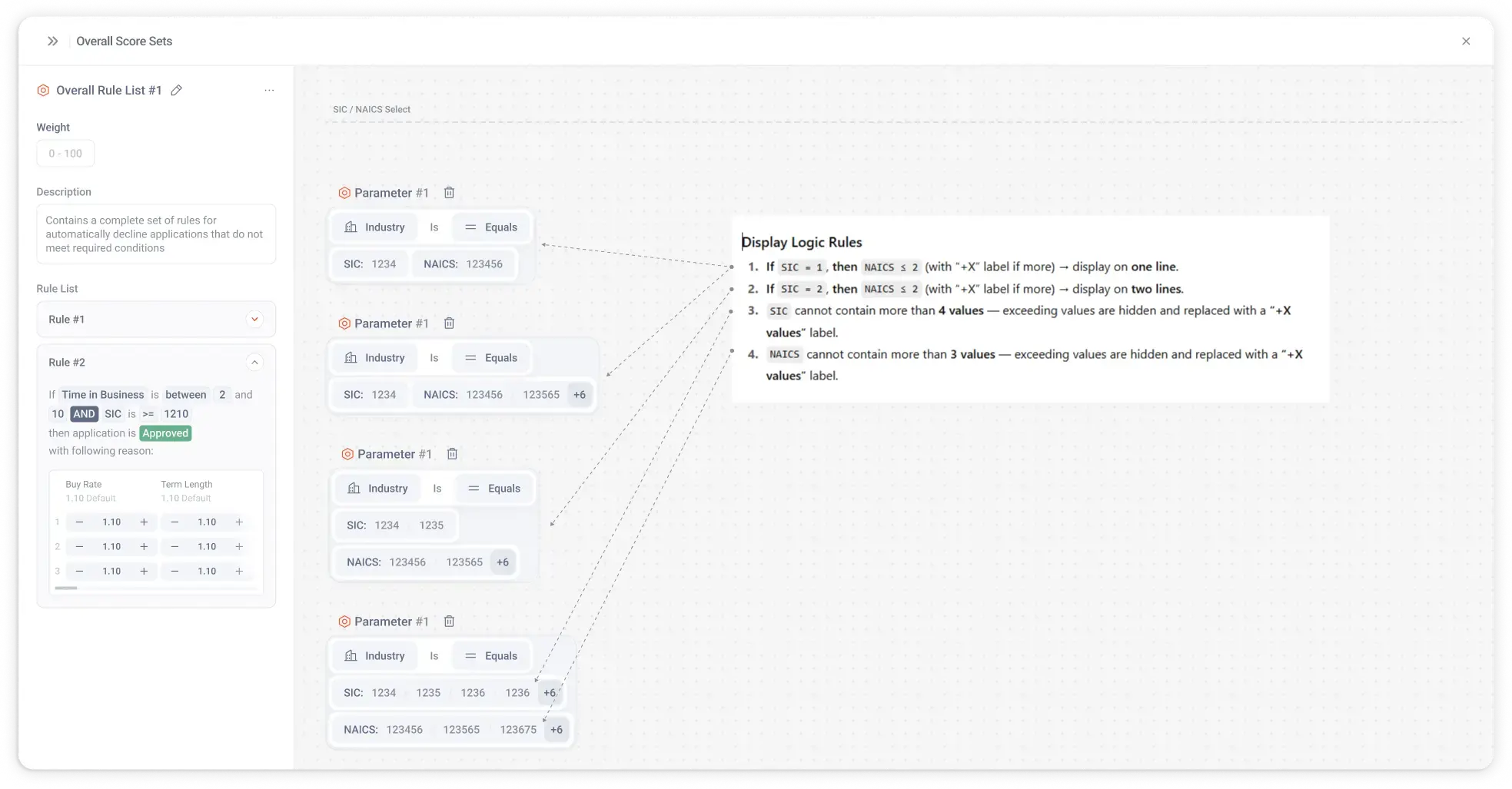
The reason your team parks non-standard work in Excel is that the software can't bend to it. Onyx IQ is built to be configured to how you actually run deals. The scorecard is a rule-based engine you set with your own weighted criteria, so your FICO bands, time-in-business minimums, industry rules, and deposit requirements run on every deal instead of living in a formula sheet.
Underwriting fields, columns, stipulations, fees, terms, and payment frequencies are configurable, so the deal types that don't fit a default template still fit the platform. And when something is truly specific to your shop, custom development is available to handle the build rather than sending you back to a spreadsheet.
The edge cases that used to fall outside the software are the ones you configure into it.
The Syndication Spreadsheet
This is the one almost every funder keeps in Excel: syndicator participation, splits, management fees, and who's owed what after each remittance.
Onyx IQ handles MCA syndication inside the platform. You add syndicators to a deal with their percentages and fees, and payouts calculate and distribute automatically from cleared funds. Your syndicators log into their own portal to see their deals, performance, and balances, so they stop calling your ops team for updates and you stop maintaining the participation sheet by hand.
The Positions and Balances Tracker
Funders track open positions, outstanding balances, and payment status in spreadsheets because their old system couldn't show it live.
Onyx IQ holds all of it on the deal record through live servicing and collections: active RTR, balances with and without fees, payment status, and renewal timing, updated as payments clear. The tracking spreadsheet has nothing left to track.
The Commission Spreadsheet
Commission owed to ISOs on funded deals is another common Excel job.
In Onyx IQ, commissions populate automatically into a dedicated queue on every funded deal, you pay them out by ACH or mark them paid in the platform, and clawbacks are supported when a deal reverses. Your team stops reconciling a separate commission sheet against funded deals.
The Pricing and Underwriting Model
When a platform can't hold your credit rules, your underwriters keep the real model in Excel.
Onyx IQ's no-code scorecard lets your head of credit build your actual FICO thresholds, time-in-business minimums, industry rules, and deposit requirements as logic that runs on every deal. The model moves out of Excel and into the system, where it runs the same way on every file.
The Capital-Partner Report Build
Every time a bank or investor asks for a report, funders on a fragmented stack export the data and rebuild it in a spreadsheet.
Onyx IQ generates borrowing base reports, static pool and collection curves by vintage, and GAAP-ready month-end output natively, from the same data that funded and serviced the deals. Your finance team stops rebuilding the report by hand for every request.
How to Test MCA Lending Software Coverage Before You Buy
Before you sign anything, bring your list of edge cases to the demo and make the vendor run every one live: the deals that don't fit the standard shape, the reports your capital partners require, and the pricing logic specific to your shop.
If the platform handles them, your spreadsheets go away when you go live. If it can't, you'll know exactly which spreadsheets you're keeping and what they'll cost you.
Either way, you decide that now instead of finding out three months after you've signed.
.webp)